[Our last blog post focused on Walt Frazier in his expanded role as the veteran leader of the New York Knicks in the mid-1970s. This post jumps ahead to Frazier’s waning NBA years in Cleveland leading to his humbling release. No need for a long intro. Frazier’s body of work speaks for itself. So, let’s jump right in with Frazier on the mend in Cleveland, literally and figuratively, and anxious to reclaim his all-star credentials. At least that was his hope. What follows was published in the Cleveland Press on September 13, 1979 under the byline of Doug Clarke, then one of the finest sportswriters in town.]
****
Well, The Man’s back. Says he wants to play some ball, too. He walked into the Cavaliers’ office today, shook hands for the first time with coach Stan Albeck, and everything was cool. Surely, Judge Crater cannot be far behind.
For much of the past two years, people have been working on mysteries without any clues as to the whereabouts of one Walt (“I’m no longer Clyde”) Frazier. That he is here is news. It’s a start, a beginning, a jumping-off point, anyway.
Last year, Walt Frazier played 12 games. Count ‘em. Twelve games. If he wasn’t on the bench, which was seldom, he was hiding in the whirlpool—or in New York, or at his house in Aurora, Ohio.
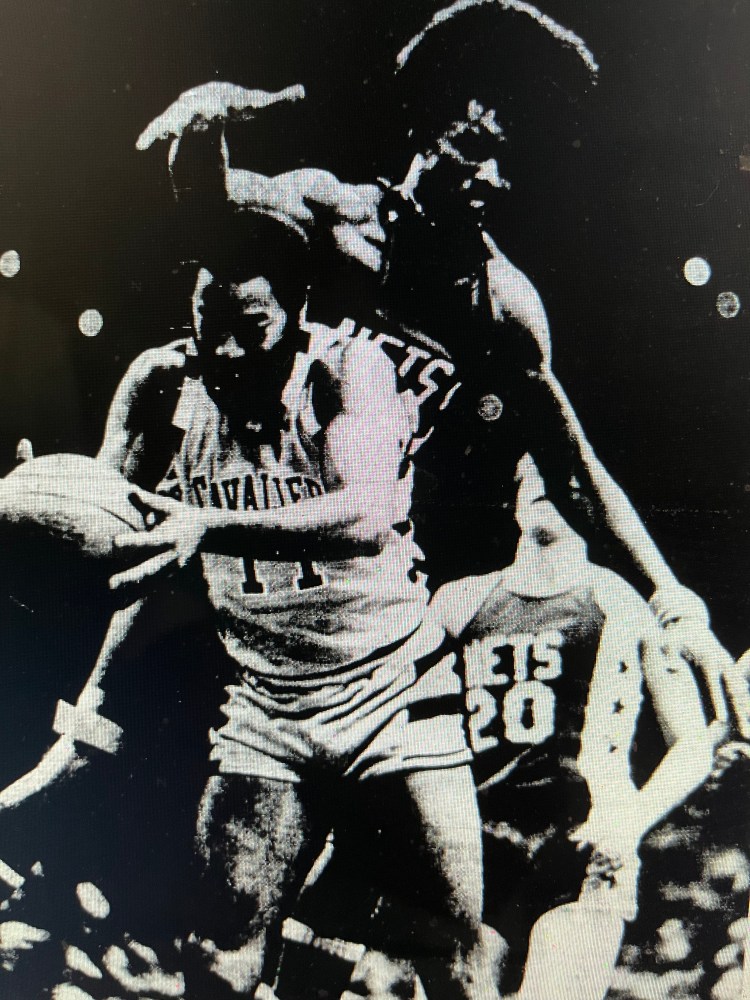
An enigma, they called him. He had a bad foot, he said. [Coach] Bill Fitch intimated it was in his head. In time, the fans’ questions of “Where’s Clyde?” changed to “Who cares?”
What a way to go out. The classiest guard of the 1970s, the man who made those wonderful Knick teams go, was leaving the game without a whisper of class. People would say, “He tokened it the last year.”
Yesterday, Walt Frazier sat in the New York office of his agent Irwin Weiner and talked on the phone with The Cleveland Press on many subjects—his injury, “tokening it,” Fitch, last season, and his goals.
His voice conveys sincerity.
“Listen,” he says, and now it is evident that Frazier is eager to tackle the ghosts, to dispel the shadows of doubt. “There were rumors that I didn’t want to play last year. That was ludicrous. I was injured. Period. If I didn’t want to play this year, I could say, ‘I can’t play, I’m hurt,’ and they’d still have to pay me. That’s a plain legal point. But it’s not going to be that way, because I want to play.
“The people in Cleveland think I’m arrogant. I do like my privacy, and I don’t hang out with the guys, that’s true. But it wasn’t out of any arrogance. I just felt out of it. I would be in a whirlpool before every game, and writers would come in and ask Fitch, ‘How’s Walt?’ Hey, I was right there. I’m not the kind of guy to defend myself, so I stayed out of it. I let Fitch tell his side of things.”
The problems between Fitch and Frazier began two years ago, when the Cavs were about to play the Knicks in the playoffs. Frazier had just injured his foot and couldn’t play. The Knicks won the series in two straight games.
Fitch, meanwhile, was hinting to the papers that Frazier was dogging it, that he wasn’t really hurt that bad. Fitch’s comments cut Frazier deeply.
“No, it didn’t make me feel worse. I couldn’t feel worse, because no one felt worse than I did after being injured. I wanted to play against the Knicks, to beat them in the Garden,” says Frazier.
Then came the Portland Incident. On a West Coast swing early last season, Frazier, who had reinjured his foot in San Diego, told trainer Charlie Strasser that he felt well enough to play against the Trail Blazers. At the time, the Cavs were one player over the limit. Fitch put Footsie Walker on the injured reserve list.
“The day of the game, my foot felt awful. I told Charlie to tell Bill I just couldn’t play. He hit the ceiling,” says Frazier.
The ceiling was in the locker room, and Fitch, sources say, told Frazier to step outside into the hallway. “He said he would punch me. I told him to go ahead. We didn’t fight, but we came close,” says Frazier.
After that, the bottom fell out. Feelings between the two degenerated into open mistrust—if not total animosity. “The problem I had with Bill was that he would sit down and talk to me, tell me one thing, and then go to the newspapers and say something entirely different. It was like he was lyin’ to my face. I lost all respect for him,” says Frazier.
“I don’t think it was just Walt Frazier,” he continued. “Bill doesn’t hit it off with anyone. He wasn’t prejudiced against me. I think he would have done the same thing with any player. It was a long season.”
Frazier’s hoping this one might be a little different. “I’m looking forward to playing. I’m always optimistic this time of year. If everyone stays healthy, we should do okay. Albeck seems like a nice guy.”
After spending most of the summer at his house in the Virgin Islands, he says he’s in top shape. “I feel great. The foot is fine. I spent the summer in the water, sailing, snorkeling, stuff like that. It’s a great place. I did a lot of jogging on the beach. When I retire, that’s where I’m going to live.”
This summer, when [owner] Nick Mileti was shopping for a coach, he told Frazier that he wanted to talk to him. Frazier flew up [to Cleveland]. Mileti had a message for Frazier. The message was: Go out with class, Walt. Do it right. Make ‘em remember you.
“I felt good about that,” says Frazier. “I was delighted that the owner of the team showed concern over me. I listened to what he had to say.”
Today, this minute, Walt Frazier has it in his mind to go out of the NBA in style. To be, even if it is just for 20 minutes a game, Clyde Cool one more time.
“What I want,” says Frazier, “is to change their conception of me. I want them to remember Walt Frazier, the basketball player.”
[Cavs coach Bill Fitch might have been gone, but Walt Frazier wasn’t in the clear in Cleveland, neither was he, at age 34 and nursing a bad foot, coveted by other NBA teams. Five games into the new season, the American sportsworld received a seismic tremor when the Cavs placed Frazier on waivers. Veteran New York reporter Milton Richman fills the rest of the seismology in this nationally syndicated article, dated October 23, 1979.]
Walt Frazier is all prepared for it, so it won’t come as that much of a shock.
This is the day he’s likely to find out, officially, nobody else in the NBA wants him, and that in all probability his playing days are finished—unless some team battling for a playoff berth later on decides to pick him up near the end of the season.
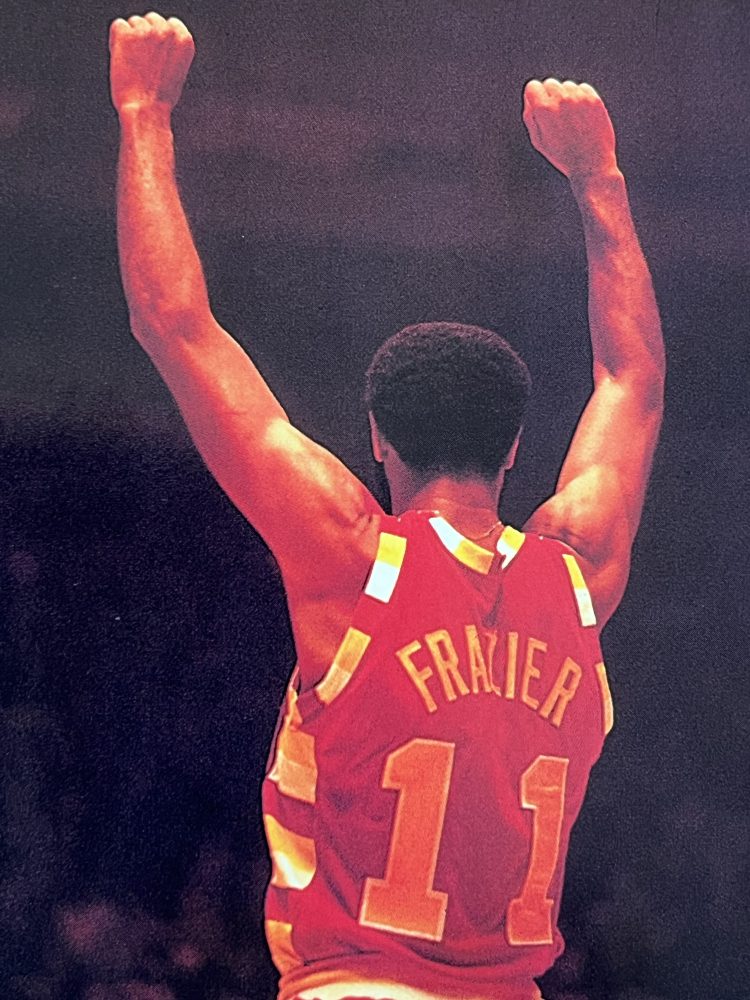
The Cleveland Cavaliers asked waivers on Frazier last Friday, and those waivers clear today. Up to now, nobody has put in a claim for him. The chances are nobody will, either, when you consider he was out practically all last season with a bad foot, he’s 34, and carries a $400,000-a-year salary.
Most of the basketball people you talk to are saying what a shame it is Walt Frazier has to go out this way. Walt Frazier, the fellow they called “Clyde,” the player who was the backbone of the New York Knicks for most of his 10 seasons with them, and the one who provided their fans with so many thrills.
Why, the Cleveland Cavaliers didn’t even give him a special night with which to send him off, they’re saying. How heartless of them. How unthinking could they be?
But hold on a minute. There is another side to the coin.
To begin with, Frazier never announced his retirement the way Havlicek, Bradley, and those others did. He had every intention of continuing to play this year, and when you stopped to think about it, he spent virtually all his career with the Knicks and only the last two seasons in Cleveland. So I don’t see why everybody is pointing a finger at the Cavaliers. If anybody should give Walt Frazier a night, the Knicks would seem the logical team to do it.
Nick Mileti, the Cavaliers’ principal owner and president—and as outgoing and generous an individual as I’ve ever come across in sports—feels as badly about the circumstances surrounding Frazier’s leaving as anybody else.
“In all my experience, I’ve never met a classier guy or a finer gentleman than Walt,” the Cavaliers owner said to me over the phone from his office in Los Angeles Monday. “We’re a young rebuilding team with emphasis on speed. What happened to Walt was no fault of his. He just no longer fit into the new framework of the team we’re building.
“If we were still playing the patterned offense, where you walk the ball up the court, then there’d be a place for him yet. But we’re not doing that. We’re playing like San Antonio now—running, gunning, and trapping. In Walt’s case, it was purely a case of his being out of sync with us. Our new style is just a little too quick for him at this stage of his career.”
Frazier, who played in only 12 games last season for the Cavaliers, will still receive his entire $400,000 salary this year even though he will not be with them. After incurring what first was believed to be a bruised instep, Frazier and Bill Fitch, the Cavaliers’ former general manager and coach, got into a disagreement over the extent of the injury. Fitch felt Frazier could play, and Frazier said he couldn’t.
After the season ended, Fitch, who had an impossible job trying to balance water on both shoulders in his dual capacity as GM and coach, left to go with the Boston Celtics.
Mileti, whose idea it was to change the basic concept of the Cavaliers’ style, conducted an intensive search for exactly the type of coach he wanted and came up with Stan Aleck, former assistant under Los Angeles Lakers head coach Jerry West.
At the opening of the Cavaliers’ camp last month, Frazier showed up with the enthusiasm of a rookie. Gradually, though, as Albeck kept concentrating more and more on speed and the fastbreak, it became evident Frazier would have trouble fitting in. And so, ultimately, waivers were asked on him.
Mileti, who was in Bowling Green, Ohio, at the time where his school there was naming a building after him, had a long talk with Frazier before the action was taken. He hopes the 12-year NBA veteran doesn’t go out with a bad rap pinned on him over what happened last year.
“He doesn’t deserve it,” said the Cavaliers boss. “He should be remembered as one of the best.”
[Walt Frazier cleared waivers, and the 1979-80 NBA season moved on without him. But not for long. In mid-December 1979 as was the decent thing to do, the Knicks feted Frazier at Madison Square Garden. Writer Nat Gottlieb captured the moment in the syndicated article, which I found in the Jersey Journal, dated Dec 15, 1979]
The flamboyant clothes are gone now. He sits there in a relatively conservative, tan tweed suit, a touch of suede at the collar. He is no longer “Clyde,” the image having been peeled off and hung in mothballs along with the flashy suits that no longer suit him. Walt Frazier will be back in Madison Square Garden tonight. He will hear the tears again and remember how it was when the place was rocking and the guy named Clyde could palm the city in his hand, just like a basketball.
The Knicks will honor Walt Frazier in a ceremony preceding the Boston Celtics game, and there will be those in the sellout crowd who will wonder why management cast him away in the first place. Walt Frazier neither wonders nor cares.
“It was a good thing being traded, because it was the final thing that made me a man,” Frazier said yesterday at a Garden press conference. “I am at peace with myself now.”
There were those who regarded Frazier’s trade to the Cleveland Cavaliers on October 7, 1977, as a fall from grace. Some were shocked. Others put off by his wild lifestyle, snickered. “Let’s see how the Clyde Show plays in Cleveland,” they said.
For the record, the Clyde Show did not play very well at all in the snowy exile that is Cleveland. Frazier played 51 games for the Cavs that first year, then just 12 the following season. He came down with an assortment of ailments, spending most of the year on the injured reserve list. Bill Fitch, who was then coach, griped privately that Frazier was faking it. This season, Fitch took over the reins in Boston, and the new Cavalier coach, Stan Albeck, unceremoniously waived Frazier.
Yet for all the emotional hardship, the 34-year-old Frazier refuses to look back in anger. In fact, he considers the trade a blessing in disguise. “At the time I was hung up on being Clyde, the superstar. It was more than just culture shock being sent to Cleveland. I mean, one day I was riding high in New York, the next day I was down on the ground in Cleveland. I was proud and arrogant before the trade, now I am a humble man,” Frazier said.
Frazier remembers the day well.
“I can recall it like it was yesterday,” said the man who helped guide the Knicks to two world championships. “It was a Friday night, and I had been out shopping. I think it was around 8 o’clock. I pulled into the parking lot of my building, and I saw Irwin Weiner (Frazier’s agent) there, and I thought to myself, ‘Now what’s he doing here? What happened.’ Irwin came over to me, and he looked real grim. He said, ‘Clyde, you’ve been traded.’ I think I said, ‘Damn.’”
The talk was that new coach Willis Reed, a former teammate of Frazier’s, had decided to clean the house of veteran talent. Frazier was asked yesterday why he thought he had been traded?
“I can only say that Willis . . .” Frazier stopped in midsentence, then continued, “. . . I can’t even say that. I think Willis had a lot of confidence in Ray Williams, that Ray could step right in. Also, I guess he felt he had a chance to get a younger player in Jim Cleamons,” Frazier said.
Frazier—who spent 10 seasons with the Knicks and set numerous club records, including field goals (5,736), assists (4,017), and points (14,617)—does not consider his having been waived by Cleveland a disgrace.
“When it happened, I was bothered. But I didn’t feel it was a disgrace, because I wasn’t embarrassing myself when I played. I didn’t even know what waivers were. I had never thought about it. I was hoping to have a storybook ending to my career.
“To me, this is a happy ending. I have no hatred, no complaints, and I have my fame,” Frazier said
Tonight, Walt Frazier’s friends will honor him.
[Here’s another perspective on Walt Frazier Night from New York-area sports columnist, Al Mari. I found this one to be more heartfelt and honest in a way that spoke more directly to the average Knick fan. Mari’s piece appeared on December 17, 1979 in the White Plains (N.Y.) Reporter Dispatch. One more thing under the heading: Irony. The Knicks played the Celtics on Walt Frazier Night. That meant Bill Fitch, the new Boston coach and former thorn in Frazier’s side, had to watch and, hopefully, cheer along with the sellout crowd the Knick great whom he’d denigrated in Cleveland, rightly or wrongly.]
Saturday night at Madison Square Garden—a night on which Walt Frazier was honored—sadness, happiness, and joy were so intermeshed that it was impossible to explain how a person felt.
Seeing the old Knicks once again—Dave DeBusschere, Willis Reed, Cazzie Russell, Mike Riordan, Dean Meminger, and Phil Jackson, among others—a person had to feel the greatness of those teams that epitomized brains, brawn, and beauty.
Hearing Frazier talk to the jam-packed crowd, one had to laugh at his usual dry humor. Watching the Celtic bench (Dave Cowens in particular) in awe of the great Knicks made a person feel warm inside and reminded us once again of the true camaraderie that great professionals feel for one another.
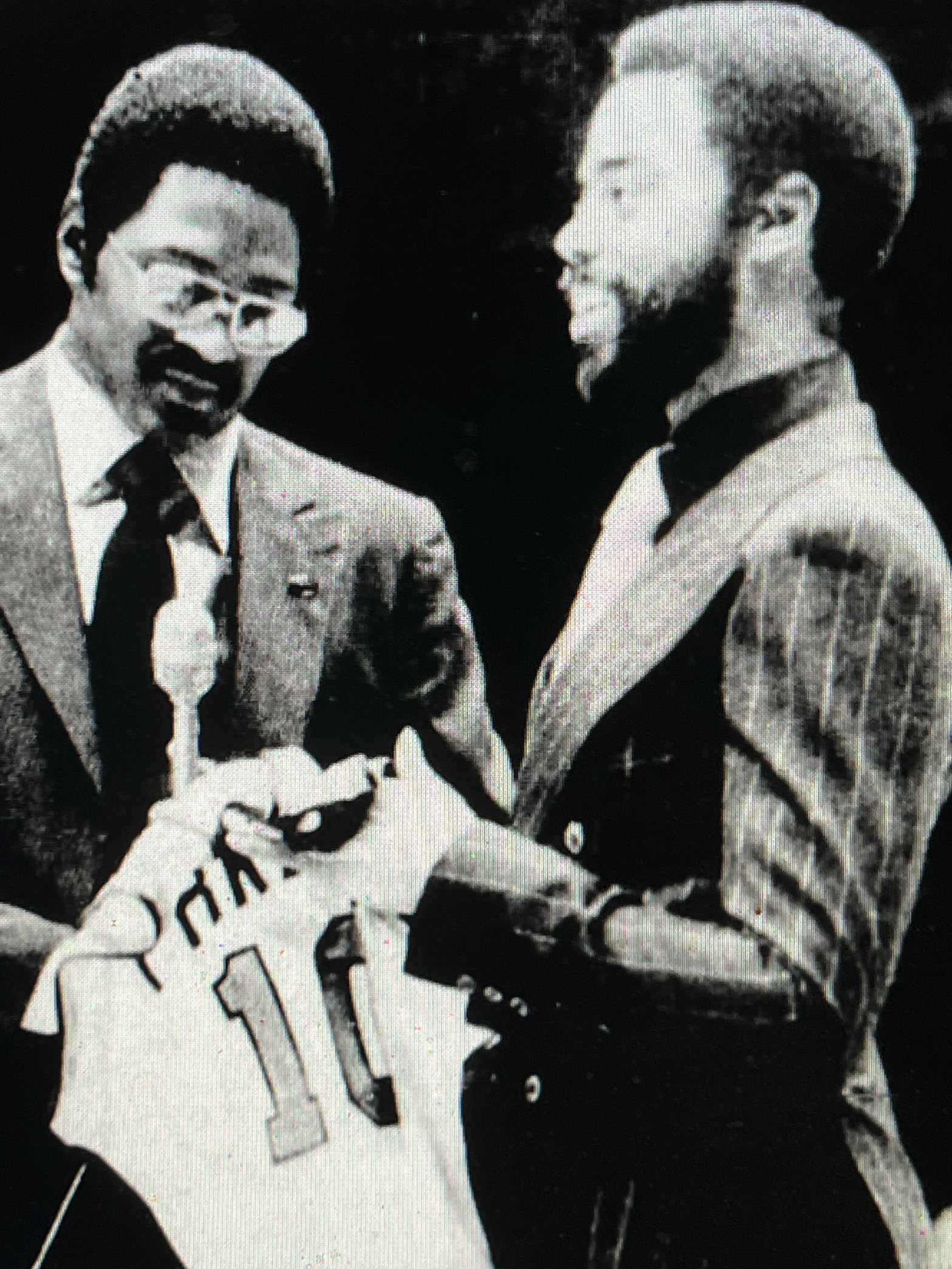
Aside from Frazier, DeBusschere drew the greatest ovation in a photo finish with Reed, who climbed out of a hospital bed to present Clyde with No. 10 so it could be retired. As the gray-haired, rugged-looking DeBusschere stood near midcourt, the crowd started the electrifying chant: “DEE-fense, DEE-fense, DEE-fense.”
They remembered the glory of defense. It was a chilling feeling. An hour later, as the Knicks battled the Celtics, the crowd once again started the chant in the third period. It was hollow, almost an echo, because every time they started it, Nate Archibald or Larry Bird hit an open jumper.
To hear some of the new-breed Knicks mock the old days—as some are now doing—it has to make you wonder if this crew, with all its latent talent, will ever amount to a team rather than a mob in the same uniforms.
Yes, the new Knicks stood and cheered for Frazier as he walked out on the court to the tune of “Seems Like Old Times.” But they weren’t alone. The entire press contingent at courtside, including nearby several venerable columnists, also stood and applauded the man who helped make the Knicks a magic word.
“A lot of people,” Clyde said, “are responsible for my success. But 10 years ago, I wouldn’t have admitted that . . . behind every good man . . . is a good woman, and I have many. Hey, where’s the list? . . . I thank the New York Knicks organization for drafting me. They knew talent when they saw it . . . I thank all my teammates present. Without them, I would have been good . . . because of them I was great.
“And I want to thank you, fans, the greatest in the world. The fans were our sixth man. Because of them, I thought anytime I stepped on the court, I could conquer everything . . . and I usually did.”
It was great fun, and the Celtics howled as Clyde spoke. Then the game began, and DeBusschere, seated behind the press table, watched casually. He watched as the Knicks, with no respect for the past, lost their fifth straight game.
How then, I humbly submit, is a person supposed to explain a feeling of joy, happiness, and sadness—all mashed together?
[Last and even more heartfelt is Mari’s earlier remembrance of things Clyde and those Amazing Knicks. Let’s end here, and maybe even throw in a gratuitous chant of “DEE-fense, DEE-fense, DEE-fense. Mari’s piece ran hours before Walt Frazier Night, dated December 15, 1979 in the Mount Vernon (N.Y.) Argus.]
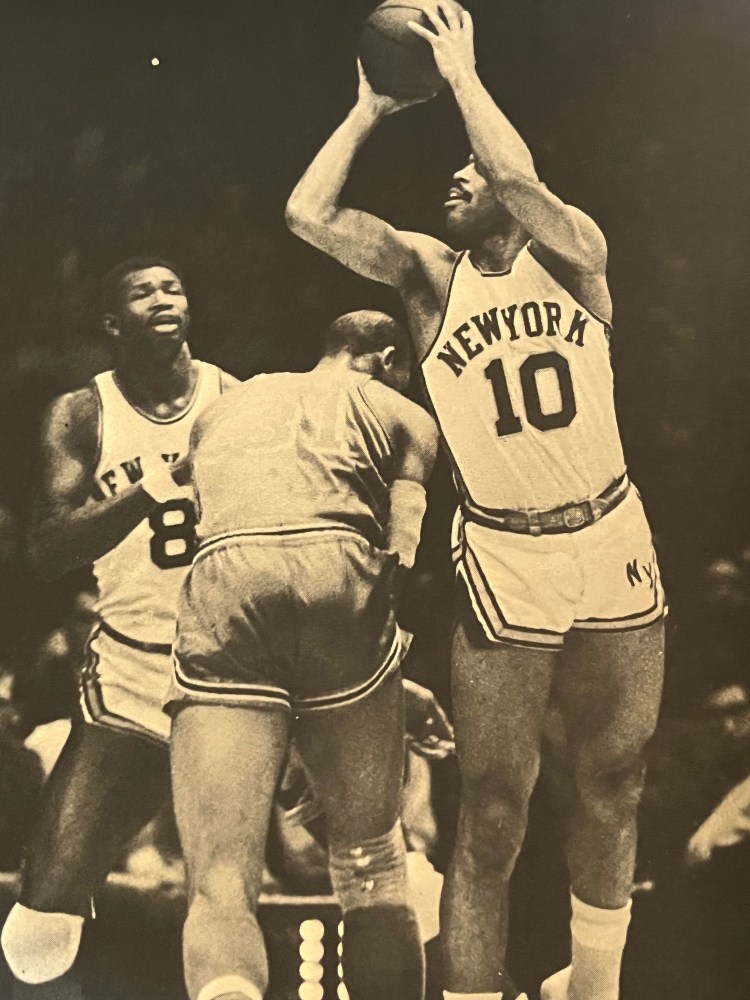
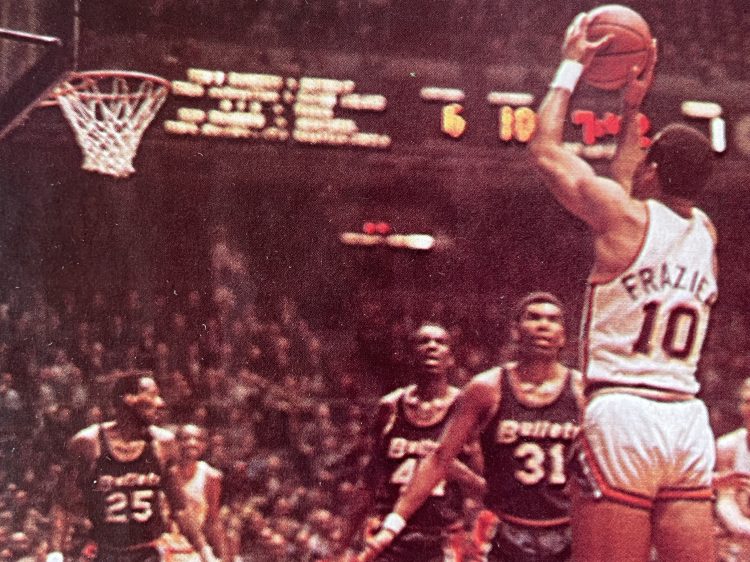
Frazier, a jump shot. The crowd loved it. The electricity was turned on.
Frazier, a jump shot. The voltage was increasing.
Frazier, a long, long jumper over Wes Unseld.
Frazier, a driving, twisting, left-handed reverse layup under and around Elvin Hayes.
Frazier, a steal from Phil Chenier and a driving, turnaround right-handed layup. The scoreboard blinked the score to the mob—102-97—with less than two minutes to play. The mob knew the veteran Knicks wouldn’t crack . . . not now. They didn’t. The executioner had done his job.
****
“Yes, I remember that game,” Walt Frazier said Friday afternoon at Madison Square Garden. “I had been booed by the crowd at the Garden the game before, and I was angry after the game. I didn’t want to talk to newspapermen. It seemed no matter what I had already done, I was always the one they blamed for us losing games.
“That was the game (April 7, 1974) that Chenier thought I hit him, and he whacked me across the neck. I tried not to get mad, but I remember I did. I never played too well when I got mad—that’s something Earl Monroe can do, but I can’t—but that time I had something to prove again.”
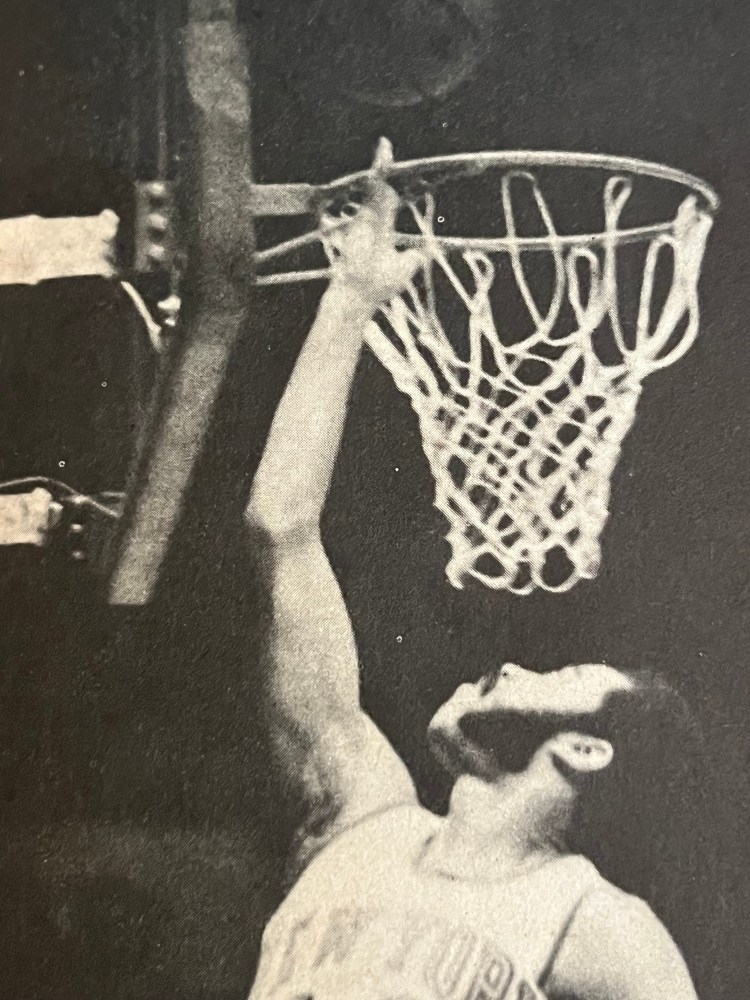
Walt (Clyde) Frazier singlehandedly won that fourth game of the playoffs against the Capital Bullets by scoring a career-high 38 points in a playoff game. The Knicks were not destined to repeat as NBA champs that year because Dave DeBusschere got hurt, and the Celtics mopped them up in five games in the Eastern Conference showdown.
That game, and the seventh game against the Los Angeles Lakers in May 1970 (36 points, 19 assists) showed what Walt Frazier was all about. It is that “all about” that the fans will remember, and that is the reason he is being honored tonight at the Garden, scene of his incredible virtuoso performances.
****
“I remember when he first came up in 1967,” Danny Whelan was saying. “He was a quiet kid. I remember I gave him number 10. He had a tough start, but once he found his place, he began wearing those clothes and doing the town. One day he came in with one of those big, wide-brimmed hats. I called him Clyde (after Bonnie and Clyde, the bank robbers). He was carrying a valise and heading for the bank. I told him he had better be careful, because he looked like a bank robber. Sure enough when he got to the bank, the guard stopped him, and he had to prove he was Walt Frazier.”
Yes, he always had to prove he was Walt Frazier. Now, with the utter bliss of two championships, the adulation of the crowds behind him, and the bitter trade to Cleveland and subsequent release still lingering, Walt Frazier goes on to a life as a man and not as one of the greatest guards ever to play pro basketball.
“I’m very proud of what people have been saying about me in the papers,” Frazier added. “They’ve been saying I had great skills and was always cool under pressure—funny thing is that I’ve always had the same feeling about myself. (People laughed along with Frazier when he made that comment.) But now it’s sad because I’m leaving something. Yet it’s a happy time because we’re having a family reunion.
“When I first came up, Red (Holzman) and Dick (McGuire) always reminded me that I couldn’t go on forever. So now I accept it and move on to something else. When I was put on waivers by Cleveland, I was bothered. I never even knew what waivers were. I was disappointed because I had worked hard to come back from my injury, and I kind of wanted a storybook ending to my career.
“And yet, the trade and the cut were the final developments in making me a man. I was big on glamour, big on the New York scene, big on being Clyde. People said I was riding high in New York and now I was grounded in Cleveland. From being proud and arrogant, I became proud and humble.”
****
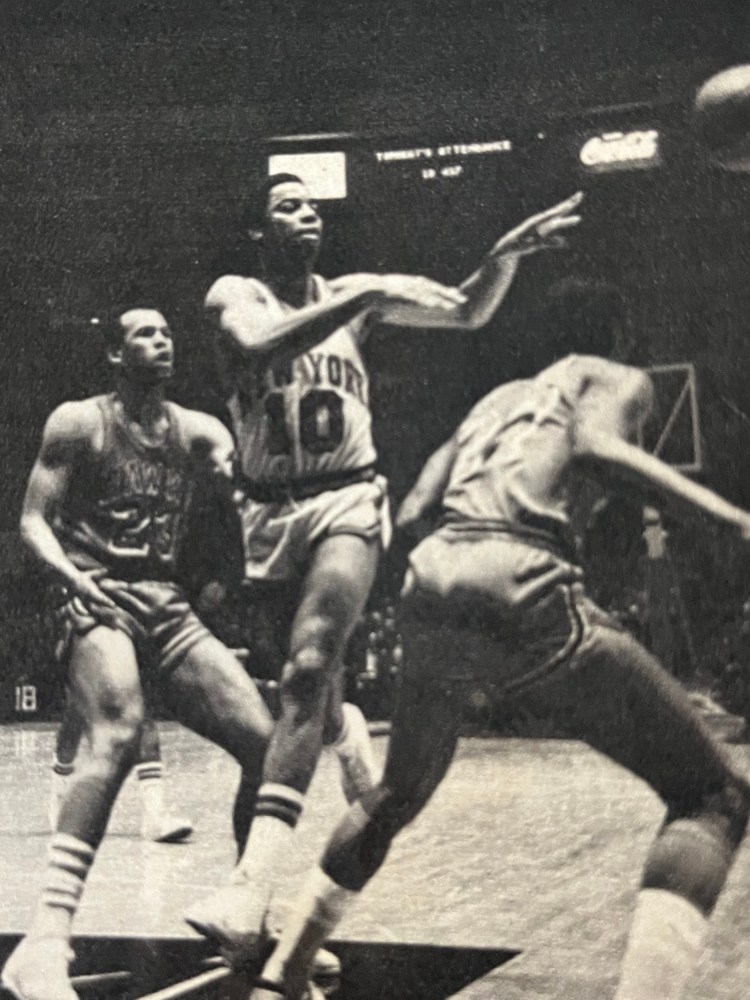
“Clyde,” Phil Chenier was saying, “drew admiration from all the guards in the league. He WAS the top guard. He played the complete game and did it flawlessly and with class. He made New York basketball, and he did a lot for me because we are similar in features. People started noticing me simply because I looked like Clyde.
“Every professional player has goals—a championship, an all-star game, scoring records, and so on. Clyde has all of them, and now he is getting a night in his honor. That is probably the highest tribute, and something Clyde will never forget. He deserves it . . . I’m very happy for him.”
“Regardless of what people say,” Earl Monroe added, “the 1969-70 playoff series between us (Baltimore Bullets) and the Knicks was the greatest single playoff series I have ever seen. It was a complete, total effort by every player on the floor. Naturally, Clyde gave them an edge. But the matchups—Bradley-Marin, DeBusschere-Johnson, me and Freddy Carter against Clyde and Dick Barnett, and Willis in the middle.
“Through it all, Clyde did what he had to do to win. He knew what he could do and when he was supposed to do it. Nobody can do it every game, but you play the part you’re supposed to. If I had to sum up Clyde as a player, I’d say he did what he had to do—his way.”
****
After 24 years of frustration, fruition came in that 1969-70 season as the Knicks won the championship. The Bullets beat them in the seventh game the following year when Unseld blocked a Bill Bradley jumper in the final seconds of the game.
“I cried after that game,” Frazier said. “I couldn’t get over it. I couldn’t believe any team could beat us in the Garden. Earl had a big game—something like 39 points—and I was guarding him. I felt that I lost the game for the team. Maybe that’s why Earl and I played so well together when we won again in 1973. We had great respect for one another.
“In 1973, it was all me. All Clyde. I was aware, I was considerate, but I thought everything revolved around me. Now, my ego has declined to 60-40. I feel fortunate because I have friends who stuck by me. It did get bad in the later years. I became a recluse and stayed to myself. And yet, I benefited by the bad years (after 1974) as well as the good years. I accept it as something meant to be, part of my destiny. I have no malice against the press, even though I started to get bad ink. I stopped reading the papers, yet it was unworthy of me to say I was through talking.
“I think I was punished for being too good. Then, when I couldn’t do what I once could, I was punished. I’ve always said that when I knew I wasn’t the best, I wouldn’t tell you guys so—and I did. But I paid my dues, and I was successful. People say it’s a disgrace to go out this way, but I can accept it. What I miss is the last five minutes of the games.”
****
“Don’t ask me any tough questions about Clyde,” Red Holzman was saying. “ Let’s say it was the injuries that slowed him down late in his career. He had a great career, and let’s leave it at that. He was team-oriented, especially defensively, so he was best suited to our style of play, and we were best suited to his talents. It was a great two-way street.
“He has a great body and actually made himself a great offensive ball player. He didn’t commit silly fouls, and if there was such a thing, he was a clean player. Don’t ask me about what happened in the last few years, here and in Cleveland. It’s his night—let’s only say positive things about him because he was a great ballplayer.
****
“People started saying Clyde was jaking it,” Whelan continued. “That’s what hurt his pride and make him stop talking to the press (during the 1976-77 season). And it was a newspaperman who was supposed to be his closest friend who started it all. Clyde wouldn’t talk to him after a game, and the guy started blasting Clyde. That’s gratitude for you.”
“Looking back,” Frazier said, “I certainly didn’t criticize the press when they said I was the greatest, so I thank you guys for making me what I am. I also have to thank you for the bad times, because that adds to what I am. I would be selfish to complain. I was a receiver for 16 years of my life, and now it’s time for me to give something back.
“I plan on living in New York, so if I could do something with the Knicks, I would. Not as a coach—here or any place—but maybe something to do with the kids and sort of a public-relations guy.
“If I had to see one thing written about me, I would like to see it said that the fans can remember me as they do remember me. I did it my way, but the team’s way and the coach’s way. That came first.”
****
Frazier, a jump shot. The crowd loved it. The electricity was turned on.
Frazier, a jump shot. The voltage was increasing.
Frazier, a long, long jumper over Wes Unseld.
Welcome home, Clyde . . . welcome home.

