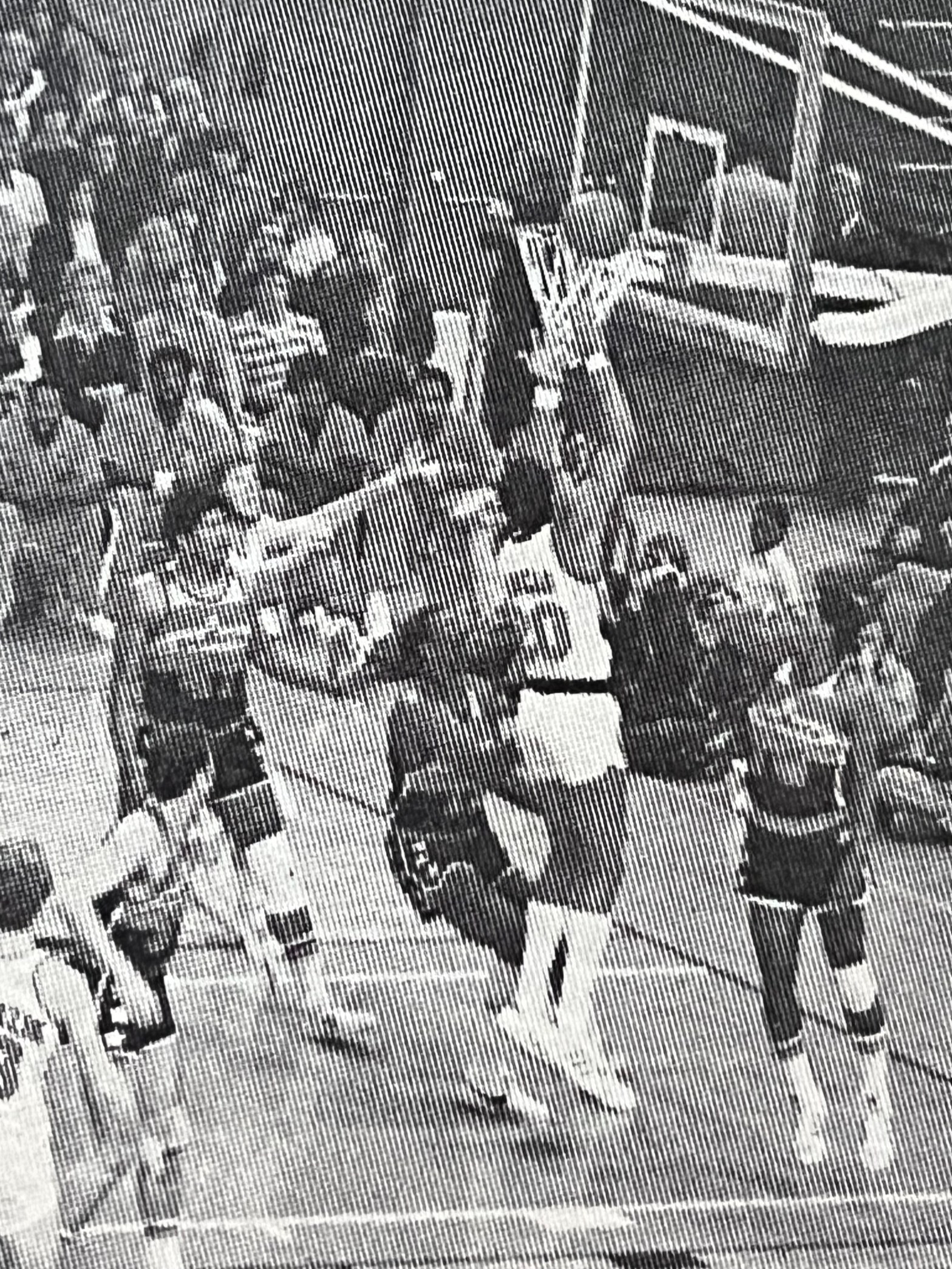
[This week we’ve had the Portland and Pittsburgh perspectives on Maurice Lucas’ NBA career. In our third-and-final post on Lucas, we finish with the Milwaukee perspective. Steve Aschburner of the Milwaukee Journal checks in on Lucas late in his pro career to see how the former Marquette University star fared with the Los Angeles Lakers. Aschburner’s story appeared in the May 1986 issue of Basketball Digest. Or roughly five months before the Lakers released Big Luke as part of the franchise’s youth movement. Lucas forged on for two more seasons, coming off the bench for Seattle then Portland. In 1988, at 35, Lucas retired after a stellar 14-season pro run in which he served as the prototype for the mean NBA power forward. Last but not least, hats off to Aschburner. He’s had a phenomenal, award-winning journalistic career and continues to shine these days with NBA.com]
****
The rich get richer, the strong get stronger. And the mean get . . . Maurice Lucas.
That’s at least one good reason the Los Angeles Lakers are stronger, meaner, and generally better this season, with a very good chance to get richer when they put their championship title on the line again this spring in the NBA playoffs.
Maurice Lucas, whose name has become synonymous with “ouch!” around the NBA, has added a new dimension to the Lakers, a new dimension and a few new colors. Purple and gold meet black and blue. As former Milwaukee Bucks guard Mike Dunleavy once said of the bruising 6-9 forward: “We call Lucas “Bogie” because he treats all of us like Bogart treated his women—with the back of his hand.”
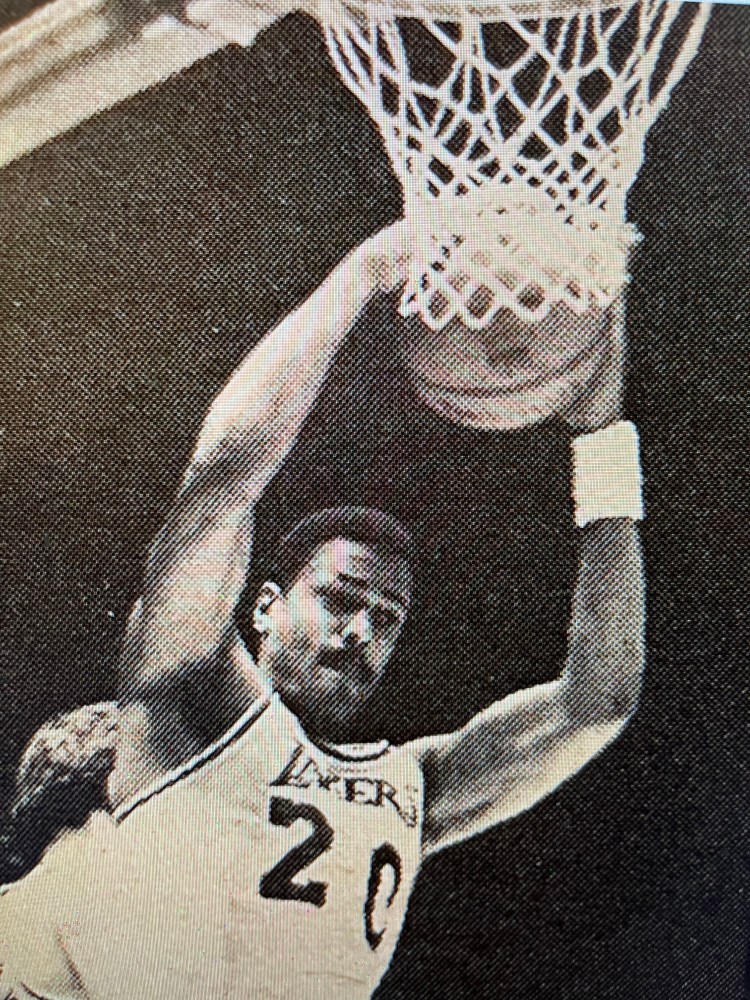
Dunleavy is lucky, though. He isn’t with the Bucks anymore, which means he didn’t have to play against the Lakers last December 18, when Lucas scored 12 points, grabbed four rebounds, and left twice as many welts in a 107-105 Los Angeles victory.
To anyone who believes in things like parity and fair play, the whole notion of Lucas being added to a team that already was good enough to win the championship last year and play in the final series each of the past four years is abhorrent. Kind of like the Chicago Bears drafting Bo Jackson or the A Team signing Rambo.
It was bad enough when the fast-breaking Lakers could beat you by beating you down the court. Now, with the addition of Lucas’ rebounding and all-around physical play, they can beat you by beating you up in the alley. Halfway through the season, Lucas was leading Los Angeles with 7.5 rebounds per game in just 22 minutes of playing time.
The bad get badder.
“Maurice is probably the key to our team,” said James Worthy of the Lakers. “He has the image. That’s the way he plays. Once you hit the wood, you better not mess with him.”
Said Pat Riley, the Los Angeles coach who obtained Lucas from Phoenix for second-round draft picks in 1988 and 1989. “It’s no coincidence that when Luke joined us, we jumped up to the No. 1 rebounding team in the league. He takes the attitude that his position is the cornerstone of the game. I think all great power forwards have that attitude.
“He’s a competitor. He’s very physical, the first player Kareem has had like that since Kermit Washington in the 1970s. Luke doesn’t go out looking for anything, but he doesn’t take anything either.”
Michael Cooper, the Lakers’ valuable sixth man, put it more bluntly. “He’s a nasty . . . .,” Cooper said.
Lucas, obviously, has a reputation. Bad dude. Tough guy. Enforcer. Hitman. He is Sonny Liston with a hangnail, [NFL defensive end] Richard Dent with a lousy contract. It’s an image that Lucas not only tolerates put revels in.
For example, responding to comments about his game face, that chilling prizefighter’s stare he uses on the court, Lucas said: “It’s a concentration level more than a stare. When I’m playing, I kind of put myself into a trance. I hype myself up to a degree of non-consciousness. Once I reach that level, then you’ll always see my eyes just bead out.”
Asked once why he elbowed Phoenix rookie Georgi Glouchkov just 13 seconds into a game, Lucas said, “That’s only because he wasn’t around me for the first 12 seconds.”
Now that’s baaad. And Lucas would have it no other way.
“It’s got me to this point, and it’s the thing that will get me to another point in my career,” he added after a game in Chicago, a game in which he, naturally enough, got into a shouting match with the Bulls’ Orlando Woolridge.
“My first year in the pros, I had to fight and scuffle and scratch for everything I got. The second year, people began to think that that was my game, and when I switched over to the NBA, that was my whole image, aura. That was how people expected me to play, and that’s what I wound up expecting of myself.
“I have a lot of fun with it. The biggest thing is, if it works for me, I enjoy it. A lot of people don’t enjoy what they do. I do.”
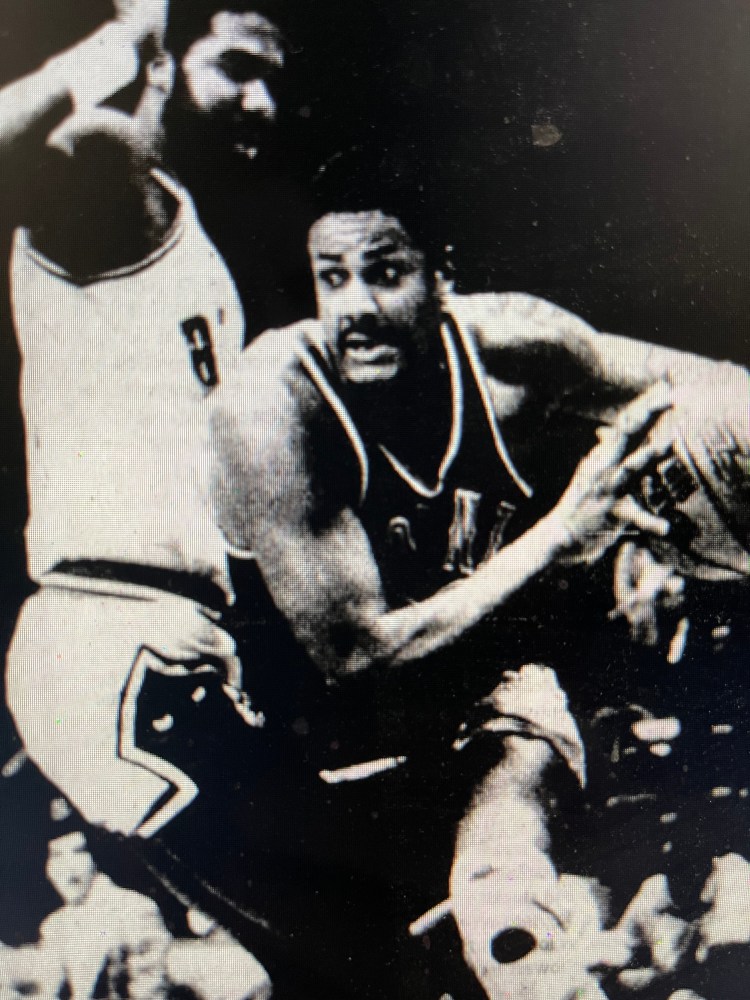
Lucas has been doing it for a long time now, longer than most people would have predicted when he left Marquette University as a junior after the 1973-74 season and made himself available for the NBA hardship draft. Then, Lucas was more mechanical than mean, a forward forced to play center for a coach who didn’t really use his skills properly.
“When I went to Al McGuire, I was great—until I got into Al’s system,” said Lucas, who, by the way, speaks in a soft voice and turns off the glare when the game ends. Lucas averaged nearly 29 points and 17 rebounds per game for Marquette’s freshman team, but those figures dropped by more than 50 percent when he joined McGuire’s varsity. Lucas’ role was basically to run from one side of the lane to the other. “Luke used to call himself, ‘The Robot,’ in our offense,” said Hank Raymonds, the assistant who coached Lucas as a freshman.
“It was a more stagnant system,” Lucas said. “There wasn’t a lot of movement. It took me until about my second year in the pros to recover from that.”
Lucas played his last game for the Warriors in the 1974 NCAA championship against North Carolina State, then was selected by Chicago in the first round of the NBA draft. Negotiations with the Bulls fell through, however, and Lucas, after flirting with a return to Marquette and possible legal action against the NCAA, finally signed with St. Louis of the American Basketball Association.
After two years in the ABA, Lucas joined the NBA’s Portland Trail Blazers in 1976 through a dispersal draft brought on by the merger of the two leagues. He averaged 20.2 points and 11.4 rebounds in 1976-77 as the Trail Blazers won the NBA championship. In the eight seasons that followed—including stops in New Jersey, New York, and Phoenix—Lucas became not only an all-star, but the quintessential power forward.
And now, at age 33, there seems to be little doubt that of all the famous Marquette players who tried pro basketball—from George Thompson to Jim Chones to Earl Tatum to Bo Ellis to Butch Lee and beyond—Lucas has done the best. His has been the longest, the most productive, and the most successful career.
“Funny, I never really thought Maurice was that good,” said McGuire.
McGuire might have underestimated Lucas’ talents, but he couldn’t miss the traits that eventually paid off for the man. They were there from the start, when McGuire went to recruit Lucas at Schenley High School in Pittsburgh. “It was a Fort Apache-type place, wild school—the halls were like track meets,” McGuire said. “But Maurice was always above that. He was always a Beau Brummel type of dresser, and, y’know, it’s tough for a big guy to be that well-groomed.
“And he was a quality person. I ran a tough ship, and in all those years, I never heard Maurice use any street language. That was the thing that fascinated me.”
Said Raymonds: “There was a discipline about him. I always said he was 18 or 19 going on 30.”
To this day, McGuire ranks the 1974 game against Wisconsin—when Lucas hit a long jump shot at the buzzer to beat the Badgers, 59-58—as his second-greatest thrill at Marquette, behind only the 1977 championship. That, too, was part of Lucas’ character.
“Maurice loved the big time. He always wanted to be in the eighth race,” McGuire said. “He wasn’t a talker, he was more of a doer, kind of a quiet warrior. And I wasn’t really aware of it until he left.”
That, Lucas said, is just the way he is. If he’s done better than some of his fellow Marquette alums—he got his degree in May 1980—well, maybe he’s wanted it more.
“I think I’ve been persistent, and from all the indications I have seen, persistence breeds success,” he said. “I’ve always been able to pull myself out of a bad situation and maintain my perspective. I’ve played with some bad teams, but I’ve still been able to perform, to consistently perform and stay aggressive.
“I’ve always enjoyed a good challenge, and every year, every game seems to be a challenge to me. It seems to be a state of war.”

