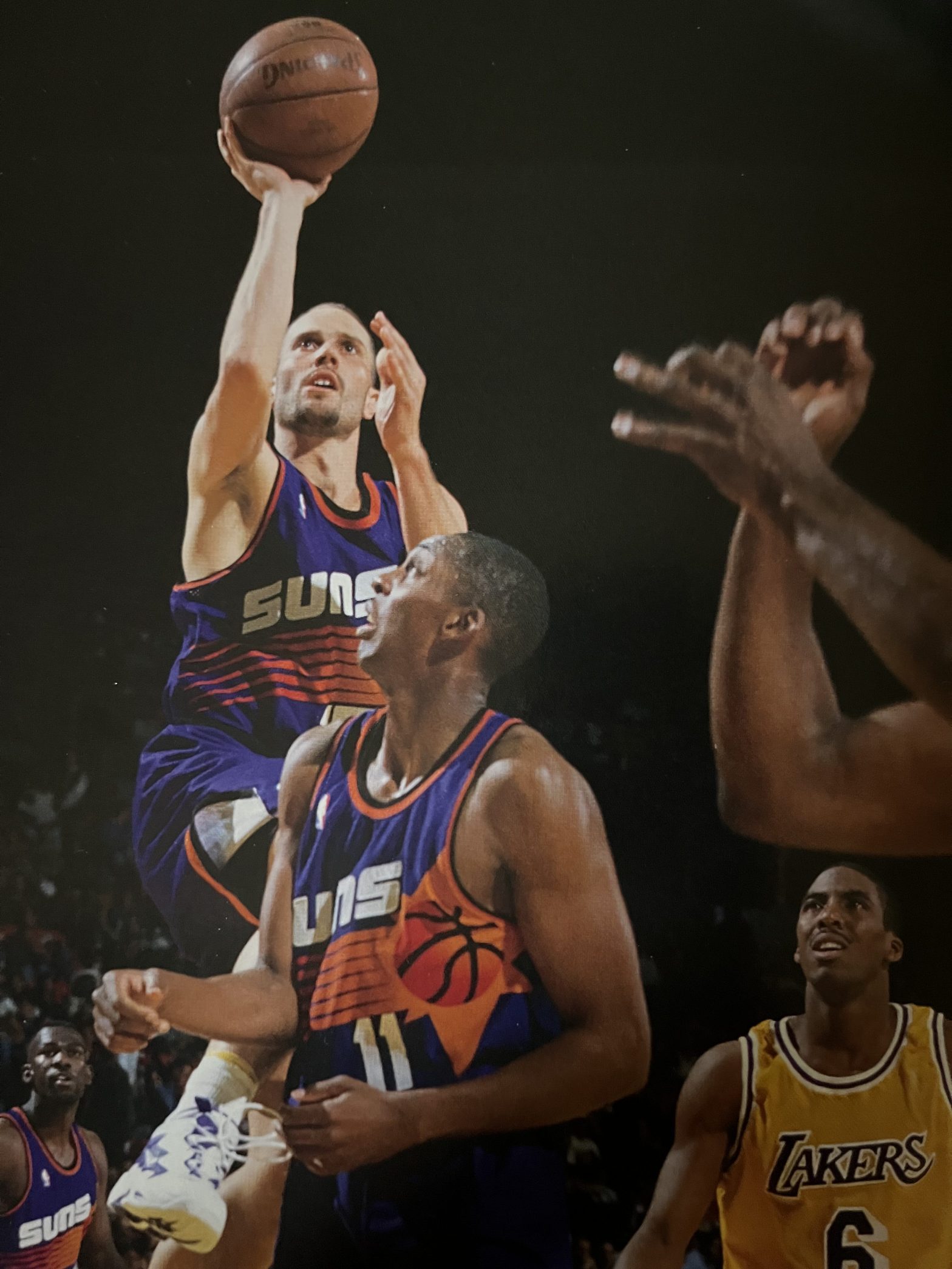
[Rex Chapman logged a solid 12-year NBA career that spiraled off by the end into what would become self-destructive battles with addiction. It’s all detailed in Chapman’s excellent book titled It’s Hard for Me to Live with Me: A Memoir, published in 2024 and well-written by the prolific Seth Davis. (He’s now teamed with Larry Brown on his memoir, due out in March 2027).
The following clip, pulled from the December 1996 issue of the Phoenix Suns magazine called Fastbreak, doesn’t delve into any of the above. Buy his memoir for more on that. Read this clip, which seems to be pre-addiction, for more about Chapman and the bigger-picture 1990s-era NBA life. Chapman, in his ninth season, has become a hired gun: a valuable long-range shooter and piece in building a competitive NBA squad. Gone are the earlier whispers of super-stardom have faded. Chapman, like most 1990s players, went where the money was greenest, his role was best, and his minutes likely would be plentiful.
Here’s Chapman’s late-career story, as penned by Jeff Munn. Name sound familiar? Munn was the public address announcer at Suns games and remains the stadium voice for the baseball Arizona Diamondbacks.]
****
In a place that used to be part of the Old West, a talented gunslinger has ridden into town. Meet Rex Chapman—The Hired Gun.
“That’s what I call him,” said teammate Sam Cassell. “The man can fire it up.”
In his ninth NBA season, Chapman signed with the Phoenix Suns prior to the start of the preseason. The Suns, in turn, gave him one set of instructions—shoot and keep shooting. Suns coach Danny Ainge noted, however, that there’s much more to Chapman’s game than just a quick draw. “Rex Chapman is an all-around solid player,” he said. “And it’s all based on Rex’s intense desire to win. He loves to play the game and will do whatever it takes to win.”
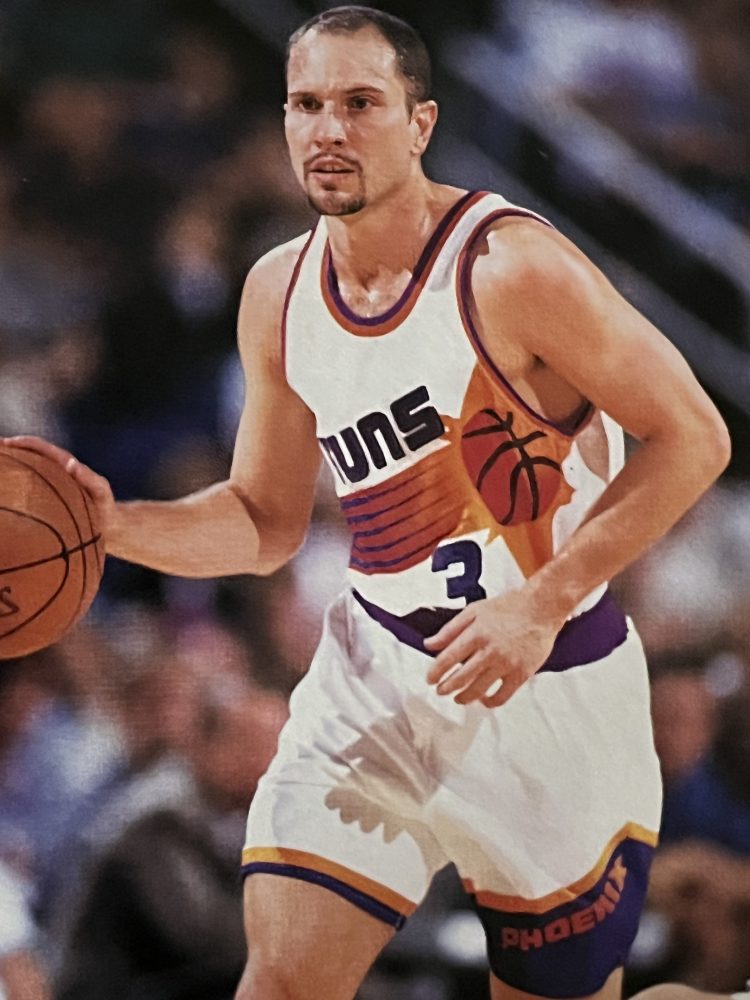
Whatever it takes is just what Chapman plans to provide. “I just wanted to do what they want me to do,” he said. “I’ve developed parts of my game because I knew it was the best way to have a long career. If you want to be in the NBA for a long time, then you’d better learn to do more than one thing well. My goals are to contribute to a winning team and stay healthy.”
For the 6-4 Chapman, contributing is no problem. The former University of Kentucky star is well known as one of the league’s top marksmen and has notches in his belt from Charlotte to Washington to Miami to back up his reputation. A career 34-percent shooter from three-point range, he’s led the team in three-point shooting in five seasons. In addition, Chapman doesn’t just have an outside shot, he can also raise eyebrows going to the basket—he’s a two-time participant in the NBA Slam Dunk Contest.
“Rex Chapman isn’t just a shooter,” Cassell said, “he’s a big-game shooter. Some guys in the league will take shots for 45 minutes, but down the stretch, they don’t want to pressure. Rex shoots for 48 minutes. He’ll take the big shot, and he’ll make it, too. I’m excited to be on the same team with him.”
Ainge, whose belief is, “You can’t have enough good shooters,” is more than happy to put that statement to the test. “Whenever you have the chance to get a player of Rex Chapman’s talent level, you do it, and you’re thrilled to have him onboard,” he said.
It should come as no surprise that Chapman is a living legend in Kentucky. But it might be surprising to know that he’s attained similar status among NBA players, most notably his new teammates. “I’ve always admired Rex, going back to his college days,” said Suns forward Michael Finley. “I followed his career from UK to the NBA. He’s a real inspiration to a lot of the younger guys, because he’s an example of what hard work can do for you.”
Chapman’s reputation as a long-range bomber can be traced to his bloodlines. His father, Wayne, played for three teams in the old American Basketball Association, which made the three-point shot popular. Today, Rex has made the “supershot” a major part of his life—he owns 3s Sports Bar and Grill in Lexington, and his jersey number is, of course, 3.
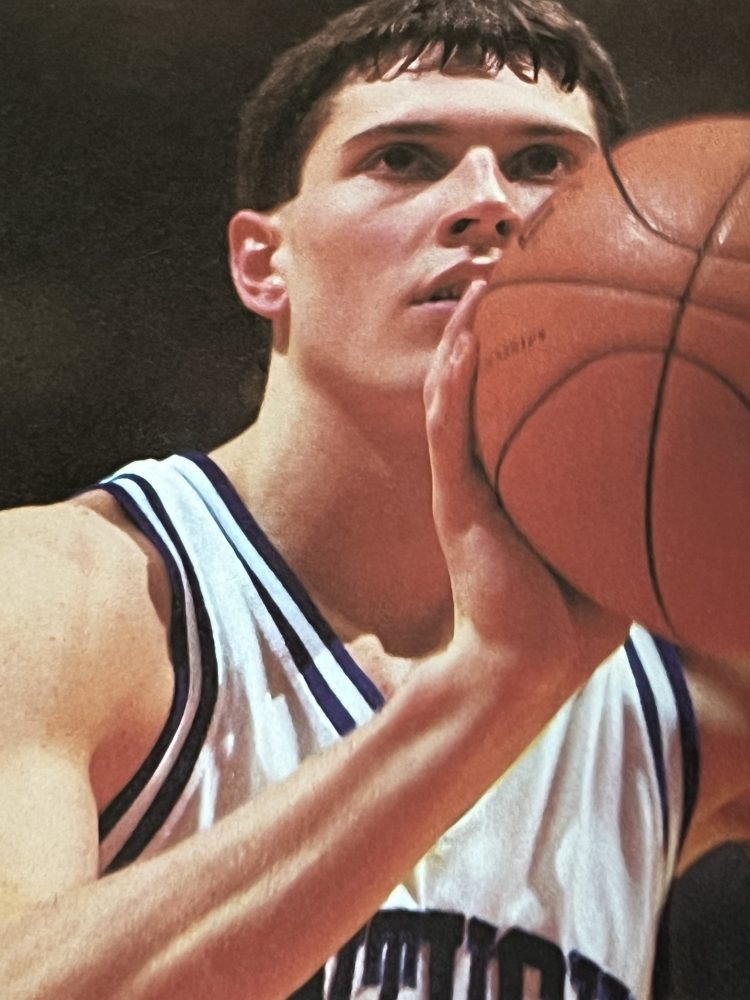
Chapman first came to national prominence at UK, where basketball is slightly more than an obsession. He was named “Mr. Basketball” in the Bluegrass State following his senior season in high school in 1986, which is the state’s polite way of suggesting where you should play college ball. After arriving in Lexington, Chapman demonstrated the first quality of any gunslinger—steady nerves. He became the first freshman in school history to lead the Wildcats in scoring (16.0 ppg), and followed that with a 19-point average in his sophomore year. His college coach, Eddie Sutton, has very vivid memories of Chapman in Blue and White.
“Rex Chapman was one of the most talented college players I’ve ever coached,” he said. “He had a great career at Kentucky, even though it only lasted two years.”
A Kentucky native, Mr. Basketball in Kentucky, and status as a high school hero might have pressured Chapman to enroll at Lexington but, true to reputation, Rex made his own decision based on his own feelings. “I was never under any pressure to go to UK,” he explained. “I was attracted to the program by the fact that Coach Sutton was there. If he hadn’t been, I probably would’ve ended up playing college ball somewhere else.”
After those two years, it was onto the NBA, a move some suggested may have come too early. Chapman would quickly prove the time was right. Outside observers thought he was attempting to leave before the Wildcats were to be put on NCAA probation for recruiting violations, but he points out now that those observers’ memories are a little fuzzy.
“All that NCAA stuff happened long after I was gone,” he said with a laugh. “I can’t tell you how many people ask me that, but my decision was based just on the fact I thought I was ready.”
Drafted in 1988 by the expansion Charlotte Hornets, an area also known as a hoop hotbed, Chapman immediately became a fan favorite. He led the Hornets in three-point percentage in each of his first three seasons. At the end of the 1990-91 campaign, Hornets fans selected him the team’s most valuable player.
“Going from UK to Charlotte was not as difficult as it might have seemed,” he said. “Having played in an environment where there was so much attention on the basketball team, coming to a city where the NBA team was the only game in town at that time was something I was already familiar with.”
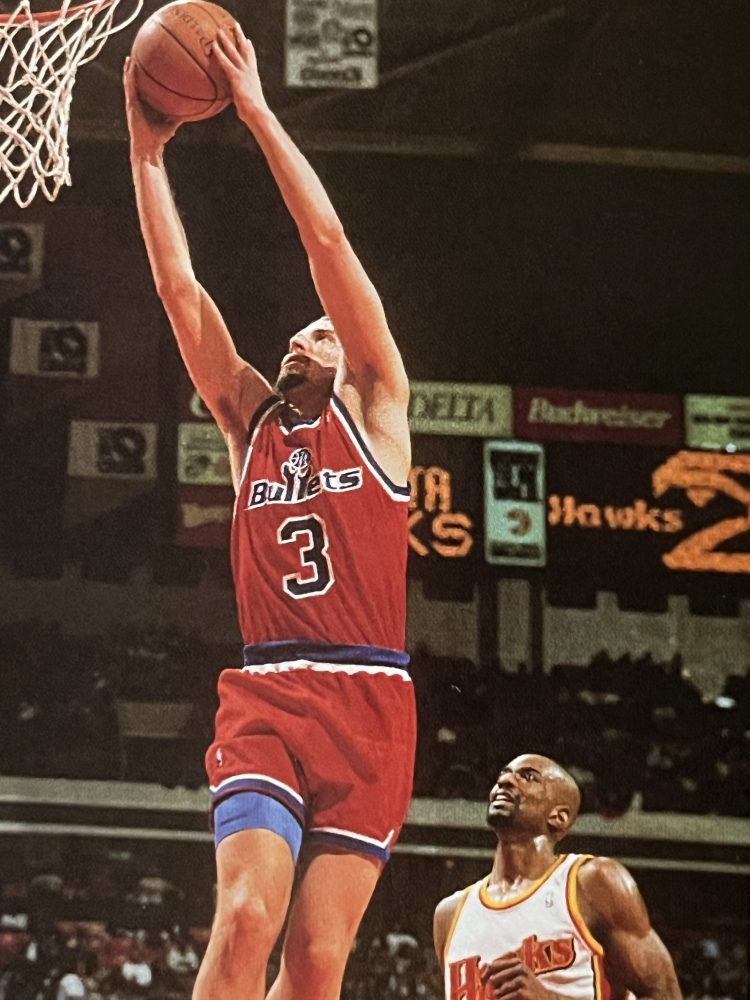
During the following season, the guard was traded to Washington. In a town where straight shooters don’t come along that often, Chapman again was on target. He led the Bullets in three-point shooting in the 1992-93 season, and only injuries could slow his draw the next two years.
“I was living in Washington when Rex was with the Bullets,” said Cassell. “So it was easy for me to follow his career. He really carried them for a long time.”
Prior to the 1995-96 campaign, Chapman was on the trail again, this time to Miami, where he led the Heat in three-pointers. His most memorable game occurred in midseason, when he tied his career high with 39 points, including nine-of-10 from three-point range, in a 113-104 upset of the Chicago Bulls. His effort earned lofty praise from his coach.
“Rex reminded me of Jerry West tonight,” said Miami coach Pat Riley. “He got us going, started making threes, and we started to build our confidence.”
As for the opposition that night, they, too, were impressed. “Rex hit some big shots for them,” Michael Jordan said. “He played extremely well for them. They rallied around him.”
“It reminded me of one of my old coaches and a slogan he had,” said Chapman. “’When a guy gets going in this league, you’ve got a problem.’”
Riley’s coaching has left a lasting impression on Chapman. “If you can play for Pat, it pretty much tells everyone around the league you can meet the demands,” Chapman said. “People know, day in and day out, the demands he puts on you defensively.”
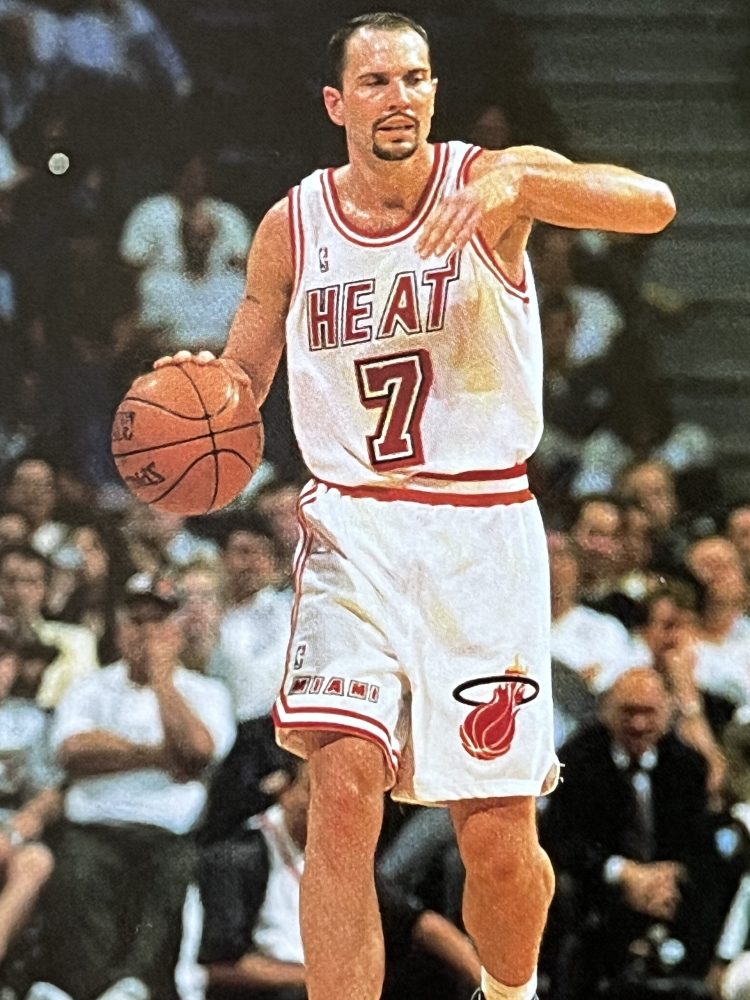
During the offseason, the Heat’s assortment of personnel moves left them unable to resign him and stay under the salary cap. Riley’s efforts to sign free agent Juwan Howard left Chapman away from the Heat and out in the cold.
“We’re going through a different time here in the NBA under the new collective bargaining agreement,” said Chapman. “And I just happened to be one of the players who got left out this time around, but what are you going to do? I’ve been fortunate to play eight years and make a good living playing this game.
“There was a time during the summer, right after the season ended, where I felt like I would be back in Miami, but things just got kind of crazy there. It just didn’t work out initially, and it became harder and harder to think about going back.”
Now this man on a shooting mission has come out West, after considering offers from other teams. “I’d been talking to Milwaukee and Indiana the last month or so,” he said. “There were different circumstances there. There were teams that had money that I could’ve gone to and played, but the situation wasn’t right, and the money wasn’t right.
“You know, it’s not always about dollars. You have to like to play this game, and this is a great organization. You never hear anything negative about the Phoenix Suns.”
Chapman comes to the Suns with one target to shoot for—being a part of a winning team. “It was tough to miss training camp,” he said. “It was one of the toughest times I’ve had as a basketball player, not knowing where you’re going to be. There were times that I thought about just not playing this year and staying in shape, but I’m glad I made the decision to play . . .”
Being that this is the first time he has played for a team in the West, there’s also a little culture shock to deal with, right?
“I think this Western Conference versus Eastern Conference style stuff is just a product of the media,” he answered. “When I played against Western teams in the past, it didn’t seem any different. Good players that play hard give their best effort, no matter where they’re playing.”
Chapman’s reputation for giving his best effort didn’t start yesterday. Just ask any of his college opponents. “Rex always had his best games in the biggest games,” said Sutton. “Our biggest non-conference opponents each year were Indiana and Louisville. One year when we went into Louisville, he had a great game. We went in as huge underdog. Rex scored 30, he couldn’t miss, and we ended up winning the game. That’s the only thing about Rex, he is a competitor.”
Despite missing out on training camp in Flagstaff, Chapman has quickly gotten in step with the Suns’ triangle offense. Through the early portion of the regular season, he has demonstrated an ability not only to knock down shots but make sure his teammates get the same opportunity. “Rex can handle the ball at the point guard position very well,” said Ainge. “His versatility is something we consider very valuable to us.”
His teammates agree. “He runs the point really well,” said Cassell, who speaks from point guard experience. “You can tell when he’s operating at that position that a lot of it comes naturally for him.”
For a player renowned for his gunning, it might come as a surprise that he has as much talent for running an offense and sticking on defense, as well. “I’m impressed with Rex’s dedication to being versatile,” Cassell said. “He works on all parts of his game. It’s a great lesson every young player can stand to learn. With all his offensive abilities, I think Rex is also a great defensive player. He really works on his defense, and it shows.”
Teammates and coaches know that this gunslinger isn’t just carrying around one pistol. “I think the people in the organization and around the league know what I’m going to bring to the team,” Chapman said. “That’s scoring, perimeter play, passing, putting the ball in people’s hands where it needs to be, and team play. I think there’s always room for that.”
The hired Sun has been asked to do a little bit of everything so far this season with the team struggling, but he’s confident they’ll turn it around. “We’ve got a good group of guys,” he said. “I think when you look at the team, you’ve got guys that know how to play the game. Everybody does everything pretty well and just knows the game of basketball. You make the most of your opportunities when you have them. That’s what this game’s all about.”
As far as his shooting touch being rusty, there was no need to worry. The preseason was enough of a warm-up for Chapman. “It’s just like playing pool,” he said. “If you’re a good pool player and you come back, your first three or four games against somebody, you’re going to forget the angles. That’s a lot like it is in basketball. If you’re not hitting the shot, don’t worry, it’ll come.
“Shooting the ball is all mental. For me, there is no thought process. Even if you struggle a little bit, you look for the shot when your team needs a big basket. You just put yourself on automatic.”
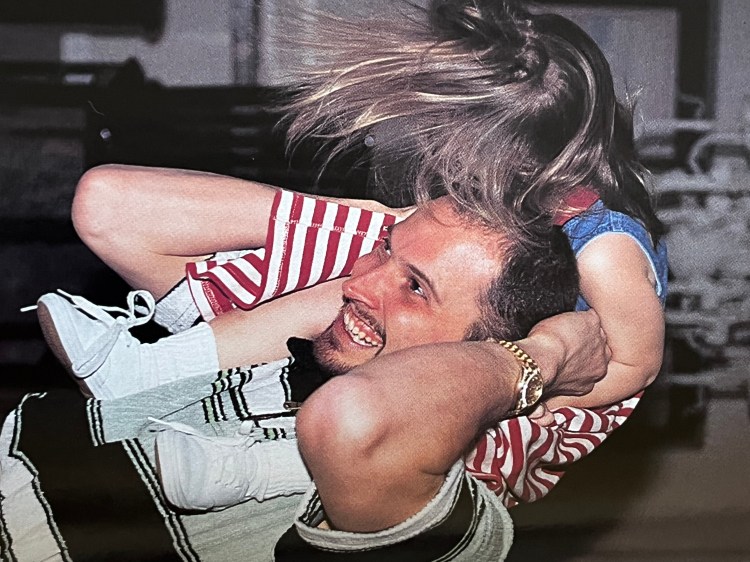
As he enters his ninth NBA season, this traveling rifleman is starting to think about putting down roots. Rex and his wife Bridgete have two children—daughter Caley, one, and son Zeke, four, who’s already a popular visitor to the Suns’ locker room after games.
“After eight years and four teams, staying in Phoenix would be nice,” he said. “You get tired of traveling and moving your family. Right now, though, my objective is to do everything I can for the Suns, and we’ll see what happens.”

