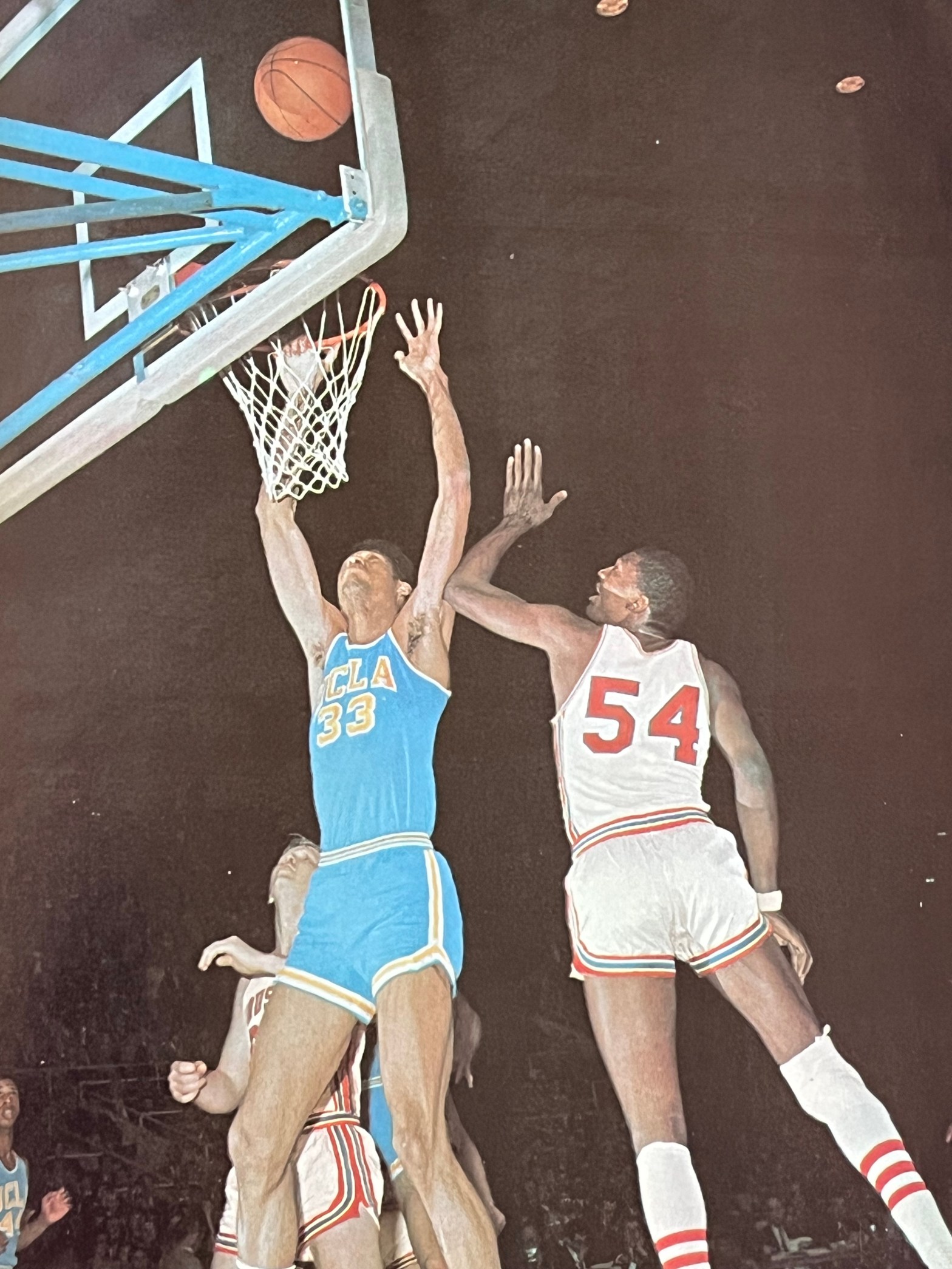
[It’s been said many times and in many ways that Lew Alcindor—today remembered as Kareem Abdul-Jabbar—ranks among the college game’s greatest of all-time for his dominant run as a UCLA Bruin in the late-1960s. It’s also well-remembered that the NBA and ABA couldn’t wait to get their grubby hands on Alcindor, then considered the pro game’s next dominant seven-footer. Less well-remembered is what everybody was actually saying back then about Alcindor and his seemingly fated future pro success.
This article, published in the March 1968 issue of the magazine Complete Sports, helps to fill the void. Phil Berger, a prolific, New York-based journalist and certifiable basketball junkie, assembled some existing quotes on Alcindor and interviewed several of the game’s top figures for their thoughts on college basketball’s then-seven-foot superhero. Most notable, IMHO, are the comments of Wilt Chamberlain, Elvin Hayes, and Nate Thurmond. A quick editorial note. In 1968, the gold standard for NBA pay was $100,000. Alcindor, of course, would get much more that that when he turned pro in 1969.]
****
Last year, Lew Alcindor led UCLA to a 30-0 record and the NCAA championship. Statistically, he had 29.0 points per game, 15.5 rebounds, and a field goal percentage of .667 (a major-college record). More than that, though, Alcindor controlled the game. When opposing teams crowded the 7-1 sophomore from New York City, he was content to pass to open teammates. On defense, he blocked shots and was an intimidating force on shooters.
Naturally, Alcindor has become the most talked-about player in the game. Not since Wilt Chamberlain was playing at Kansas University has a ballplayer been such a newsworthy figure. A great deal of the commentary about Lew has been favorable to him; some has not. What follows is a sampling of what people—players, writers, coaches, and teammates—have to say about Lew Alcindor.
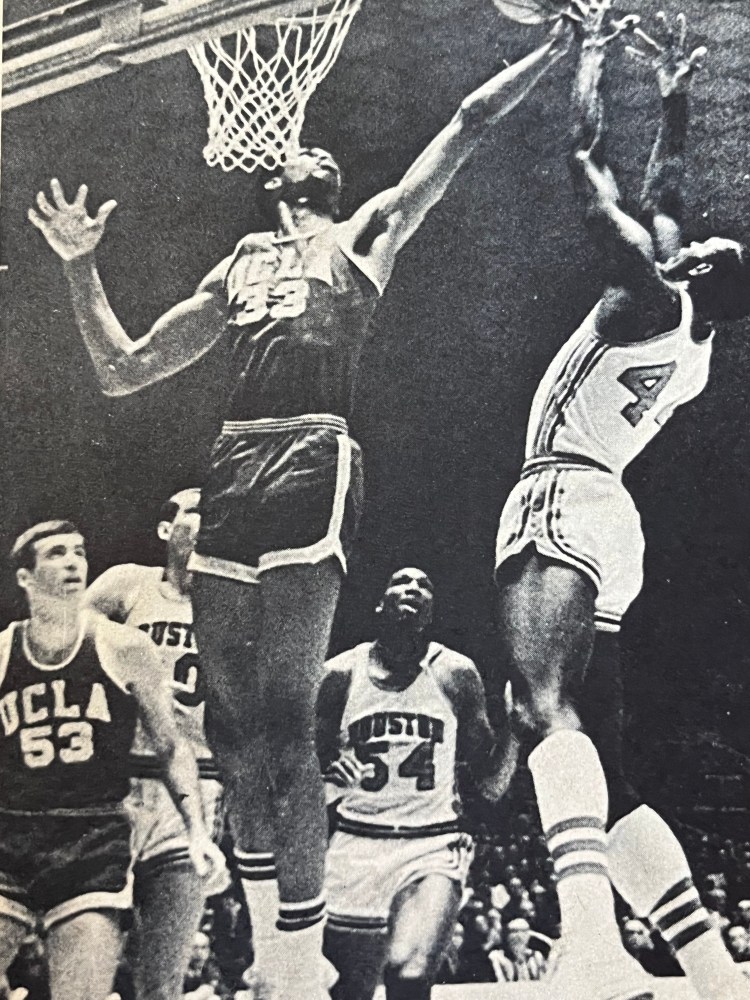
Vic Bubas, coach, Duke University (after the Alcindor-led Bruins beat the Blue Devils in back-to-back games): “He destroys you, that’s what he does.”
Don Donoher, coach, Dayton University: “Just his presence alone is a great psychological hazard. The whole team has to worry about whether they’re near him or not.”
John Wooden, Alcindor’s coach, UCLA: “There’s nobody around who can handle him alone. If you can possibly get him the ball under the basket, it’s almost impossible legally to prevent him from scoring. Sometimes, he even frightens me.”
Steve Belko, coach, University of Oregon (after his team lost to UCLA): “I think they ought to lower the basket to five feet and give everybody an equal chance.”
Al Negreggi, coach, University of Portland: “Alcindor is doing more things than Wilt Chamberlain did in college. Wilt didn’t dominate the game like Alcindor does. He is the most unselfish, and he’s always looking for the others.”
Wilt Chamberlain, center, Philadelphia 76ers: “He (Alcindor) goes well with both hands. I didn’t and still don’t. All of the centers in the pros are pretty bad with their weak hand. If we’re forced to use it, we will. But it’s not a weapon, see, to baffle the defense. Now Lew mixes his shots very well. A definite plus for him.
“I’ll give you an example. As a defender, I had lots of trouble with Willis Reed (of the New York Knicks) before (Walt) Bellamy came to the Knicks to play pivot. Willis is a lefty and, when you’re used to facing righties all the time, it affects your timing and perspective to see a lefty. So since Lew can go both ways, he’s going to be a bigger problem to defend.”
Guy Rodgers, guard, Chicago Bulls: “I played against Wilt in high school, and I’d have to say that at the same stage in their careers, Lew does all the things Wilt did.
Elvin Hayes, center, Houston University (and Alcindor’s closest collegiate rival), after outscoring and outrebounding Lew in the NCAA semifinals: “He’s not aggressive enough on the boards, particularly on offense. Defensively, he just stands around. He’s not at all, you know, all they really put him up to be.”
Happy Hairston, forward, Cincinnati Royals: ”This kid thinks in terms of the team. He’s like Russell that way. In fact, some of the things he does on defense remind you of Russell. The way he controls a blocked shot, for instance. He just doesn’t slap it away. He blocks and maintains control of the ball.”
Marv Harshman, coach, Washington State University: “He can hold you off with one hand and stuff the ball with the other. How are you going to stop him?”
John Wooden: “Lew’s made a big improvement (from his freshman year) on rebounding position. Earlier, he permitted himself to be bodychecked out a little too easily. Perhaps he wasn’t timid in his play, but a little reticent.”
Kenny Heitz, forward, UCLA: “You practically have to smash Lew in the mouth before he gets tough.”
Johnny Dee, coach, University of Notre Dame: “The only way to beat him (Alcindor) is to hope for the three Fs: Foreign Court, Friendly Officials, and Foul Out Alcindor.”
Bob Boyd, coach, USC: “When it’s man-to-man, Lew can score any time he gets the ball.”
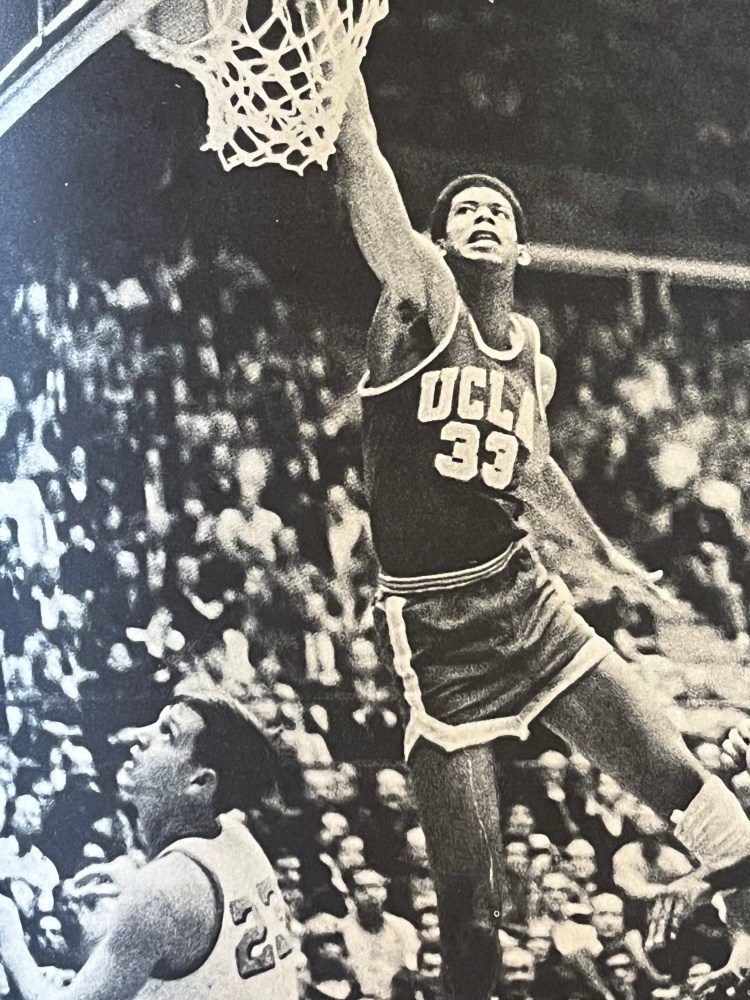
ON ALCINDOR THE PRO PROSPECT:
Nate Thurmond, center, San Francisco Warriors: “By the time Wilt and Russell are retired, I’ll have to start all over again because Lew Alcindor will be ready for the NBA. I saw him play in high school and in college on TV two or three times. I think he has the physical equipment to be a superstar in his first year. I think our rivalry will be like Russ and Wilt. I look forward to playing against him. Who’s going to be number one between the two of us? I’d like to think after my long struggle to gain recognition, it’s going to be me. I’d hate to be number two after Wilt and Russ have gone.
Dolph Schayes, former NBA player and coach: “Alcindor’s best asset will be his ability to get the other guys into the game.”
An NBA Executive: “I don’t know about Alcindor. I get the idea that he doesn’t care much for the game. An official at UCLA told me that he was the only player who didn’t show up for unofficial shooting drills after the season (of his freshman year). I think of that $100,000 he could make. If that doesn’t excite him, than I don’t know what will.”
Guy Rodgers, in response: “If he doesn’t like the game, he’s doing a good job of hiding it.”
Bill Sharman, coach, San Francisco Warriors: “He could be worth $100,000 right now.”
Red Auerbach, general manager, Boston Celtics: “Right now, Alcindor is neither the offensive man Chamberlain is, nor the defensive man Russell is. But he’s well-disciplined, and nature will make him a stronger player. Combining the two, he might turn out to be as good or better than either Russell or Chamberlain.”
John Wooden: “His potential is unlimited.”
Willis Reed, forward, New York Knickerbockers: “I’ve played against Alcindor at summer camps and clinics, and there’s no question about it—for a big man, he’s well-coordinated, aggressive, and pretty good on defense, too. If Wilt Chamberlain ever quits in a few years and Bill Russell slows down, Lew can be the number one center in the league as a rookie.”
Wilt Chamberlain: “As a ballplayer, he can go as far as he wants. He has a great body and is well coordinated for a boy his age and size. He’s bigger now, by an inch or so, than I am. His legs are well developed and strong. And he can handle the ball. He may not be as strong as me or as quick as Russell, but that doesn’t mean he can’t be a better ballplayer than both of us. It’s just a matter of making the most of what he’s got.
“You take Oscar Robertson. He’s not as fast as some ballplayers or as good a shooter as others, but he knows how to put everything together better than anybody else. I think Lew has a chance of doing the same thing.”
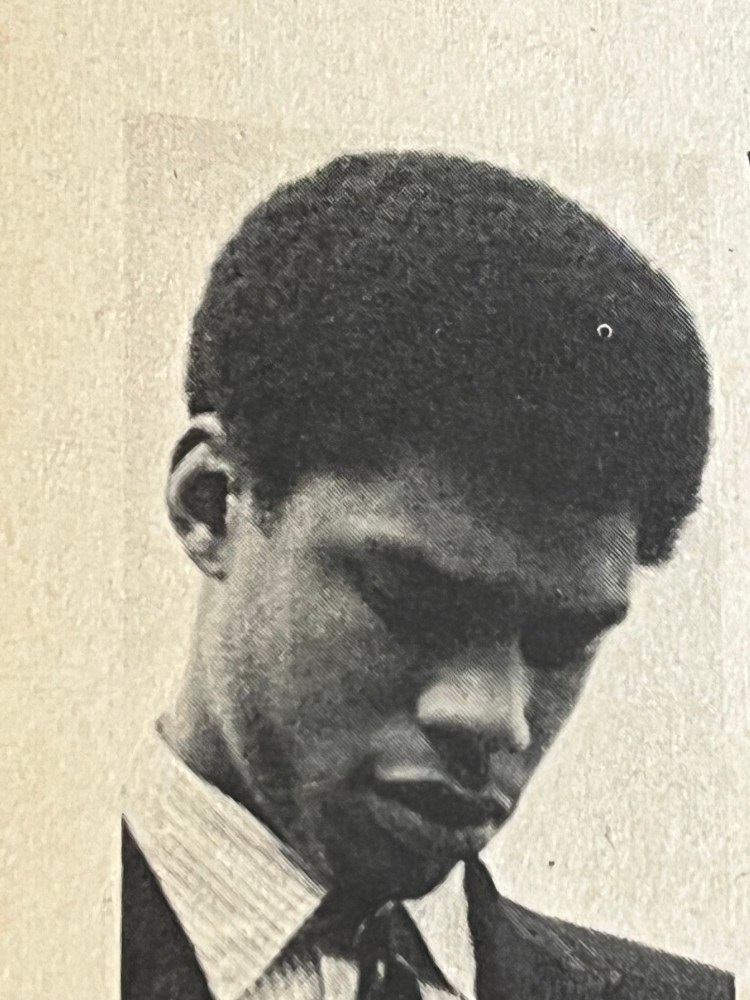
ON ALCINDOR THE PERSON:
Vic Kelley, manager, UCLA Athletic News Bureau: “Lew has a delicate, quietish sense of humor. He’s sharp . . . in the sense that he’s up on everything. His humor is a little nippy . . . the way most young persons are. The players often direct it at each other.”
John Wooden: “He’s an unselfish boy and realizes UCLA is a team. He also realizes his ability. I don’t want him imbued with false modesty. He is a modest boy, but he doesn’t have false modesty.”
Mike Warren, guard, UCLA (after L.A. papers chided Alcindor for his remarks about the “unreal” atmosphere of Los Angeles): “Most people don’t respect Lew’s thoughts, but they should. He’s very intelligent and, because he gives in-depth answers to questions, his image has come out badly. Actually, he didn’t say anything which any one of us from out-of-state wouldn’t have said.
“The guys on the team are not at all jealous of all the publicity Lew has received. But it’s a little upsetting to see him getting the short-end like he has. All of us were stars in high school, but it’s a pleasure to take a backseat to Lew. He’s a great player, and he deserves all the attention he’s getting.”
Wilt Chamberlain: “I give my advice freely to Lew. But he is a strange boy. He won’t listen to everybody. Lew has to respect you. Even then, he makes up his own mind. More power to him. He gets advice from a lot of people, but if he doesn’t respect them, he doesn’t pay any attention. I have nothing to tell him about being a seven-footer. He knows all about it. But in certain respects, he’s luckier than I was. Today, people have come to accept the fact that a man can be tall and talented and not a goon. When I came along, that wasn’t established, and it made it tough on me.”
A 6-7 NBA Player: “I’m big, but I wouldn’t trade all the money in the world to be as tall as either Lew or Wilt. I can toss on a beach hat and go to the shore, and nobody bugs me. It’s impossible for a seven-footer to make himself inconspicuous. Maybe in Europe. But how many times can you go to Europe.”
Arnold Hano, writer: “He is Plastic Man who curtly turns people away with a “no comment,” but all the while, he yearns desperately to improve his relationship with his fellow man. He is Plastic Man, yes, but buried deep within, there is a heart, and it bleeds away in its own cone of silence.”

