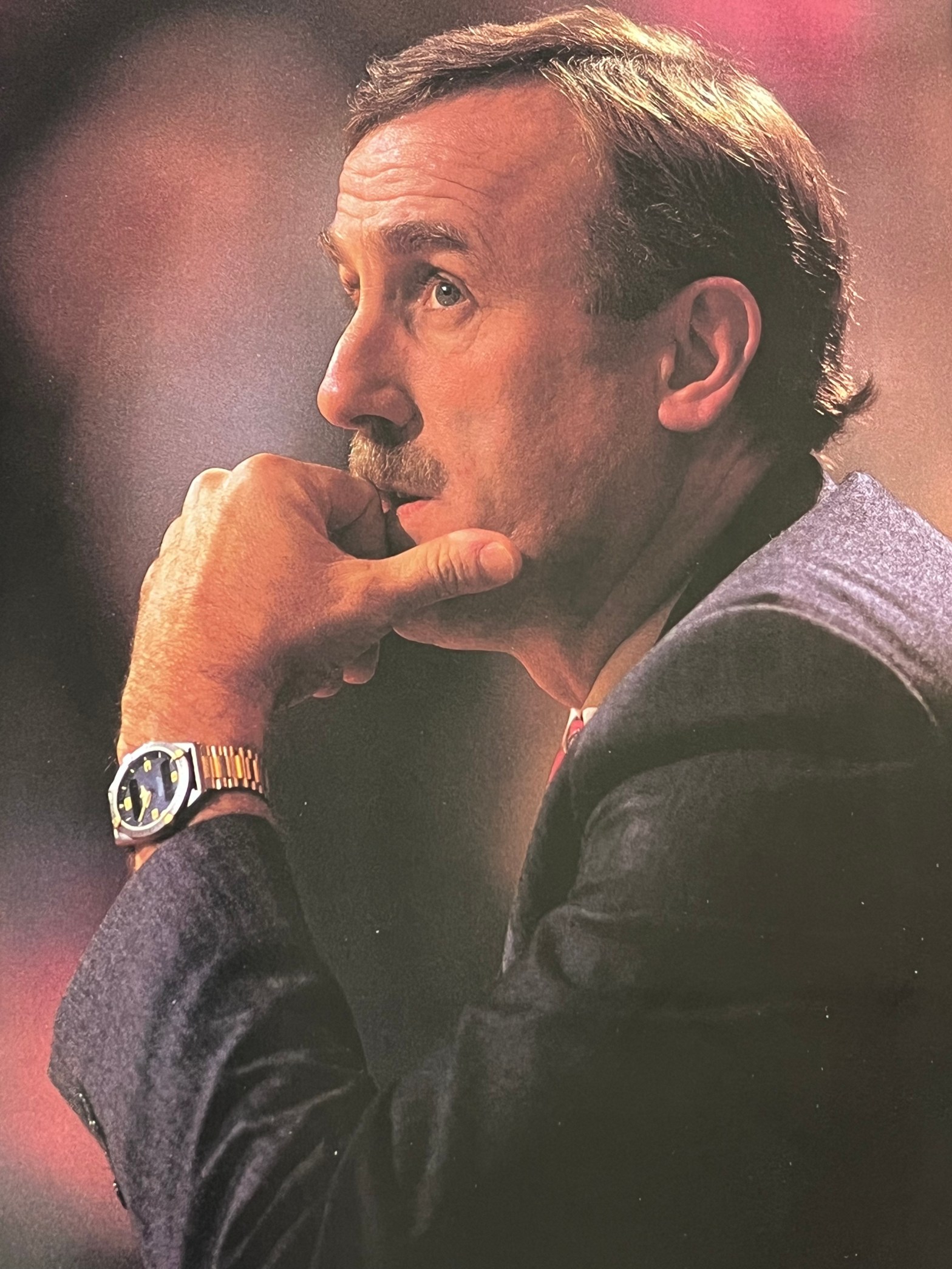
[Hall-of-Famer Rick Adelman passed last week at age 79. Several people in the know already have paid tribute to his basketball life well spent, which included seven seasons as an NBA player and 23 seasons as an NBA coach (career record 1,042-749).
Here’s another remembrance, this one from Way Downtown before Adelman’s spectacular run as with the Sacramento Kings (1998-2006). It’s a profile of Adelman at the height of his six-season tenure as head coach of the Portland Trail Blazers (1988-1994). At the keyboard is Wayne Thompson, the long-time Blazers beat reporter for the Oregonian and a scribe who knew Adelman well. Because the profile runs a little long for contemporary tastes, I’ll stop the intro here. Except to add, Thompson’s cover story appeared in the February 1993 issue of the magazine Rip City. Here’s to Rick Adelman, one of the great NBA coaches.]
****
Earlier this season, Portland Trail Blazers coach Rick Adelman earned 200 career coaching victories faster than any other coach in NBA history. In his first three seasons, Adelman’s teams have compiled a 179-67 (.728) record. Only one other coach in NBA history—Chicago’s Phil Jackson—has had a more auspicious start as a head coach in the NBA.
Looking at the record, it’s hard to fathom why some critics believe that the Blazers are a dumb team or that Adelman doesn’t do anything but sit there and watch his athletes run and jump until the slam dunks are done.
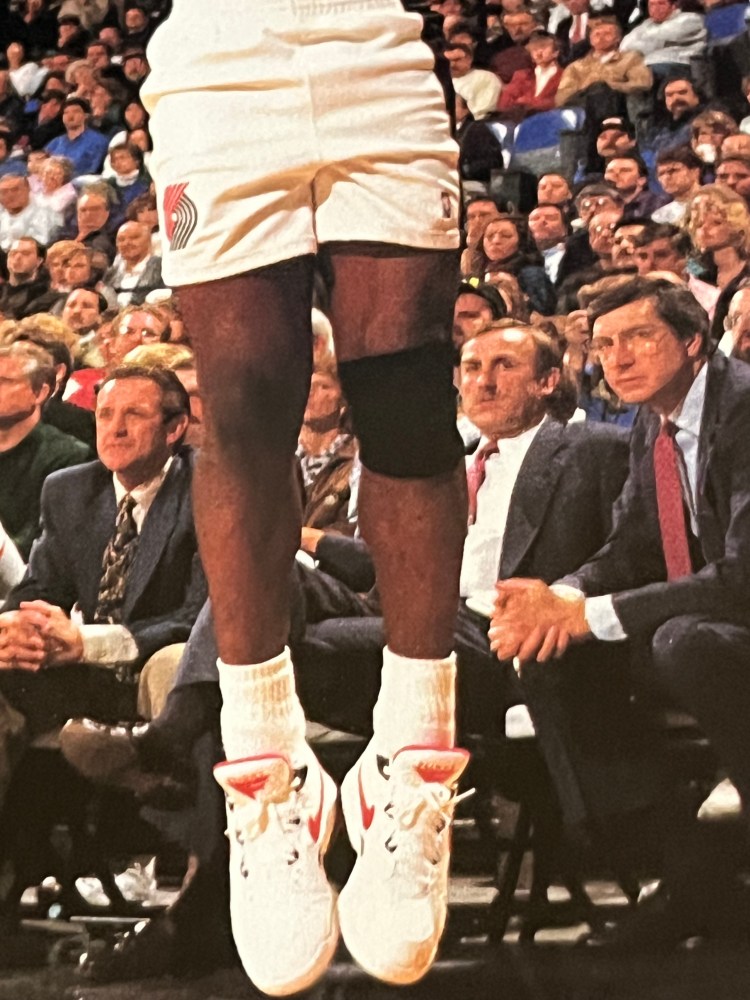
Geoff Petrie, vice president of Blazers’ Basketball Operations and a former teammate of Adelman’s on the original Blazers, scoffs at the criticism. “What it tells me is that over the last three years, 25 of the 26 other teams in the league are dumber than we are,” Petrie says. “As for Rick, he runs the Blazers on the court. He’s grown up with most of the veterans on the team. He started with them, much like Pat Riley did with the Lakers. A bond has developed between them; they respect him, and they play hard for him.”
Make no mistake, the Portland Trail Blazers are Rick Adelman’s team. Paul Allen may own the franchise, but the team that has averaged nearly 60 wins a year for the past three seasons belongs to Adelman.
Adelman denies that claim precipitously, deferring the property deed to his players. “It’s their team, not mine,” he says.
But the fact remains that Adelman, age 46, makes the critical strategy decisions for this team. He listens and accepts advice openly from assistant coaches and players alike, but in the end, the strategy—brilliant or unwise—is executed at his command.
The very thought that someone might write “the Blazers are winners because of Rick Adelman” embarrasses this modest family-man. He thrives on selflessness and seeks the comfort of shadows away from the bright lights.
Fans may dispute the claim that Adelman is the key to the Blazers’ success. Some of those fans, indeed, continue their love-hate relationship with Adelman—one that dates back more than 20 years to his days as the first Trail Blazers’ team captain.
The media don’t buy the “Adelman-made-them” theory either. They see the team that has played in two NBA Finals in the past three years as essentially Clyde Drexler’s team. If not that, they say that Buck Williams was the glue that fused the Blazers into championship contenders when he joined the team in 1990.
Adelman, to many, is just a shrill-voiced cheerleader, a skilled babysitter, and a nice guy who doesn’t get in the way of predestined Trail Blazers’ glory. Nonsense. The evidence keeps piling up. Talk to Drexler, talk to Williams, talk to Geoff Petrie, then talk to Adelman’s former coaches—Dick Motta, Rolland Todd, Alex Hannum, Jack Ramsay, and Mike Schuler. Here’s what they say:
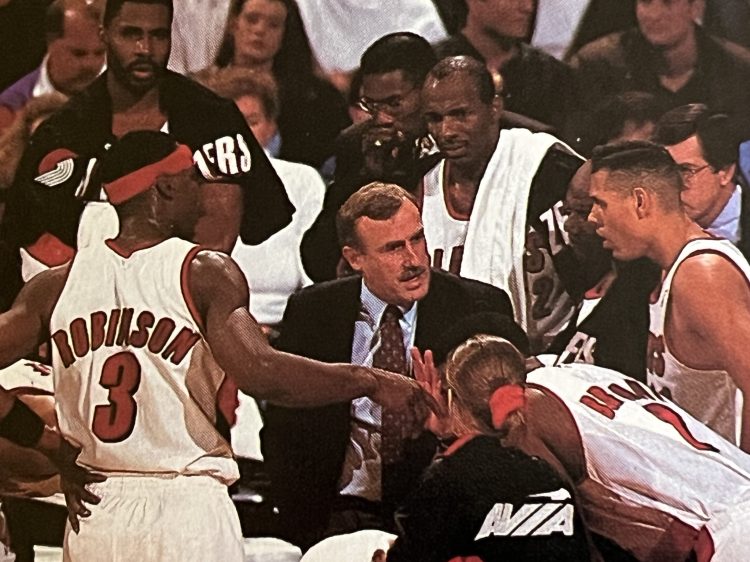
The Portland Trail Blazers, for better or worse, are an extension of Rick Adelman’s personality, character, taste, brains, and philosophy. Yes, the Blazers’ players are multitalented, but the real edge they hold over other teams in the highly competitive NBA is gained through overachievement—a work ethic that has been Adelman’s punch card since the day he first brough his lunch pail to the NBA looking for work.
“Rick has been fabulous,” said Drexler at the end of last season. “He’s done a super job.”
Drexler added: “He has many strengths; that’s one of the things that makes him so valuable. He knows the game, he knows the players, he relates well, and he’s a great X-and-O guy.”
Buck Williams, in his 12th NBA season, seconds the notion by saying, “Of all the coaches I’ve played for, I think he better understands what he wants from his players. He wouldn’t ask anything from Buck Williams or Cliff Robinson that he wouldn’t ask from himself. Players respect that.”
Respected coach? That is an oxymoron in the world of professional basketball, where far too often the high-salaried players with egos in the seven-figures have the power and the will to fire coaches they don’t like or respect.
If Adelman knew nothing of basketball, he still should be given a major share of the credit for Portland’s success because of the way his players feel about him, and the way they put out for him every night, says Milwaukee coach Mike Dunleavy.
“Rick is a terrific coach with a great record to prove it. That this team keeps on winning year after year, no matter how much stronger other teams get, should tell you something about how effectively he motivates his people,” Dunleavy says.
“You can look at his record, or you can see the way Rick’s teams play—extremely hard every night. Either way, it tells you that Portland isn’t simply a team with a lot of talent, but rather it’s a team that makes the most of its talent. That’s the coach’s doing.”
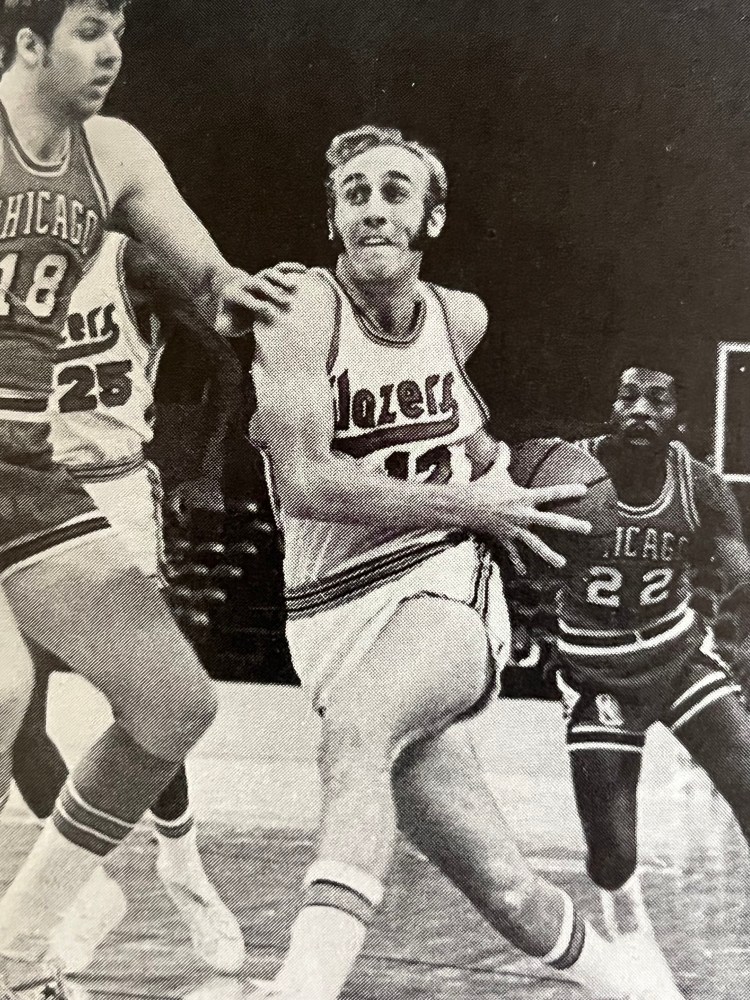
Adelman was not born to coach. Indeed, the thought never really entered his mind when he began his career at St. Pius High School in Downey, Calif., not later at Loyola University, where he scored what was then a school-record 1,415 points (an 18.6 average) in four seasons.
“At some point, I wondered what it would be like to coach a team, but I didn’t pursue it as an ultimate goal,” Adelman says. “I just wanted to play and see how far my skills would take me.”
The ultimate destination for Adelman’s skills was the NBA, but San Diego waited until the seventh round of the 1968 draft before making him the 79th player chosen. That he was chosen at all was surprising to some, but not to California insiders like Rolland Todd, whose UNLV teams played Adelman’s Loyola.
“Even before I saw him play at Loyola, I was aware of Rick Adelman from his days at Pius X. He was a tournament MVP in high school, an unselfish player with good instincts for the game and a competitive spirit,” Todd says.
Later, when Todd was named as the first coach of the Trail Blazers in 1970, Adelman was among the expansion players that Portland drafted. “I called Alex Hannum (Adelman’s coach at San Diego), and he said the same thing about Rick that I had observed: unselfish, loyal, smart, very competitive,” says Todd.
Then, as now, Adelman was a leader, but by example, not with words. “He was an intense player, fully engaged in what he was after,” Todd recalls. “His strength was that he understood his limitations; that is, he didn’t try to do things that weren’t his strengths. He uses those principles in coaching today, designing offenses to take advantage of player strengths while reducing exposure to their weaknesses.”
Todd’s sentiments are echoed by two other coaches who have influenced Adelman’s development—Jack Ramsay, who gave Adelman his first NBA coaching job, and Mike Schuler, who retained Rick as his chief assistant after Ramsay left the Blazers.
“Rick, as a player, had such a great understanding of the game,” Ramsay recalls. “He has carried those same traits, and everything he observed as a player, into his coaching experience. I liked Rick as a young player at San Diego, and I tried to get him from Jack McMahon, but he wouldn’t go for the deal. He knew what he had—a point guard who made good judgments and was unflappable.”
Well, not quite unflappable. “I thought one of his few weaknesses was that he was worried a lot,” Todd said. “Worry rarely produces anything but anxiety.”
Petrie agrees. “He’s still the consummate worrier. I remember when we were teammates on the old Blazers, we played a lot of gin rummy to relieve tension. We were roomies on road trips, and there were times when Rick couldn’t sleep after a game and, all of a sudden, the light would come on in the room at 4 a.m., and Rick would say, ‘Deal ‘em!’ We played a lot of cards during the 18-64 season,” Petrie mused.
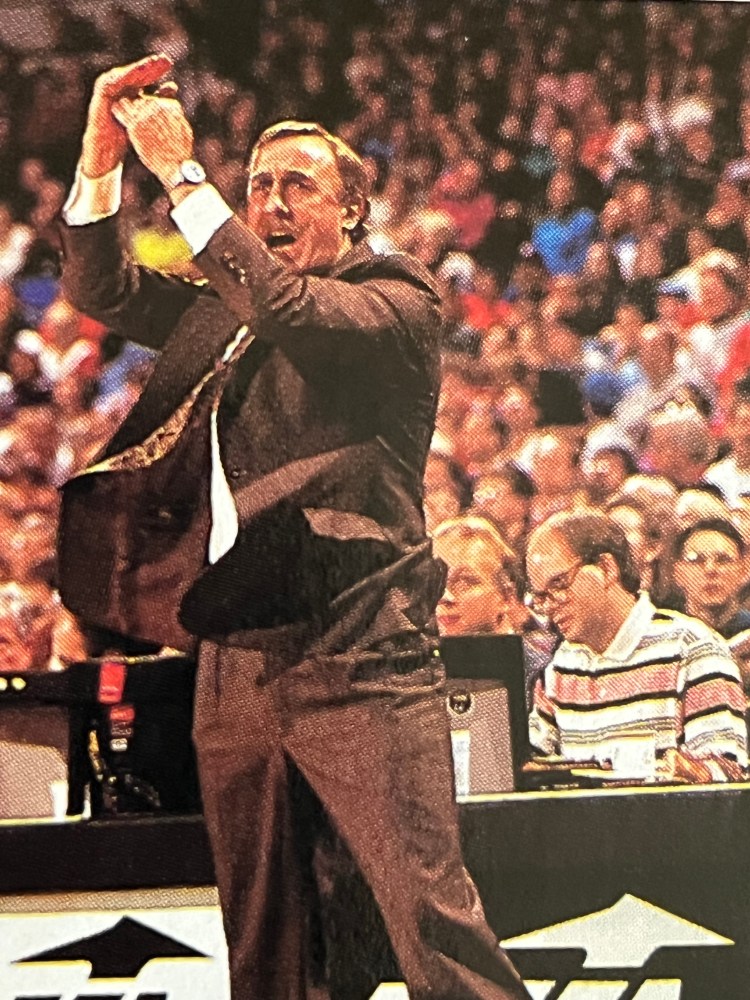
No matter whom one asks who had played or coached with Rick Adelman, the praise for his knowledge of basketball is universal. “Rick has a tremendous feel for the game, and he is so well prepared,” says Schuler.
Schuler relied primarily on Adelman’s scouting ability during his two-and-a-half seasons as Blazers head coach, But he saw intangibles in Adelman that, indeed, were lacking in himself. “I think the greatest skill is him temperament. He understands the players perspective, can look at things from their side of it.
“You walk a fine line trying to do that well. Rick knows the path. I can’t say enough good things about him. He’s loyal, and he’s dedicated. Mostly, he’s deserving of the recognition he’s finally getting around the league,” says Schuler.
Larry Steele, Adelman’s friend and former teammate for more than 20 years, and a man who was instrumental in finding Adelman his first coaching job at Chemekata Community College (Salem, Ore.), is not surprised by that success. “Having played in the league and understanding the program as a player gives Rick an edge over many coaches. Having been a point guard also makes him aware of the needs of everyone on the court,” says Steele.
“Rick’s other major attributes are his personality and character. Success hasn’t changed him. He’s still basically the same guy I played with and grew up with here in Portland. He holds the same high values that he always has held, and he hasn’t let anything spoil the way he looks at his job and his life in general.”
Ramsay agrees with that appraisal, too. “Part of Rick’s success stems from the fact that he is a superior person—a very ethical guy with sterling moral character. I admire him as a player, trust his judgments and honesty as a coach, and respect him greatly as a person. Players see that, too. Being around a coach like that instills character in the entire program. It rubs off,” Ramsay says.
Adelman appreciates the attention and the praise, but he remain skeptical of individual glory in a team sport that relies on organization, execution, and mutual respect among all the players in the program—not just those to run up and down a basketball court.
“I’ve tried to build a program that relies on communication,” Adelman says. “So much of this game is communicating, getting people to understand their roles, being aware of their weaknesses, emphasizing their strengths. I feel fortunate because everywhere I’ve played or coached, I’ve learned something valuable that helped me in my job here. I had a wonderful experience, for example, at Chemeketa. It was one of my happiest times.”
In six seasons at Chemeketa, Adelman’s teams amassed a 141-39 (.783) record, winning outright or sharing three Oregon community college championships and one Region 18 title. Holder of a master’s degree in history from Loyola, Adelman also taught physical education classes and worked as a counselor at the school. “I learned an important lesson in counseling students that has helped me in my job with the Blazers,” Adelman said. “A counselor has to learn to listen to be effective. I learned how to listen.”
Adelman, the listener, has endeared himself to his players and assistant coaches. “I’m always open to suggestions, and I let them know that. Sometimes, I will design a play, and a player or two speaks up and says it won’t work and gives me reasons. I respect that and sometimes will make changes. But in the end, it’s my decision. And they respect that,” he says.
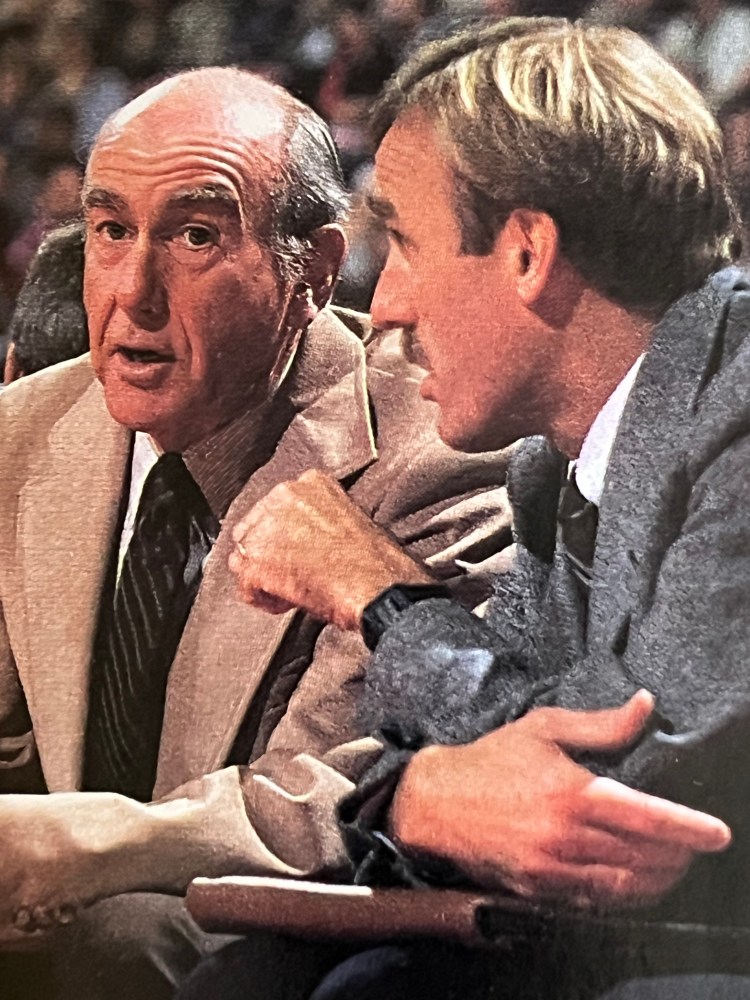
Adelman’s philosophy as a coach begins with self-awareness. “I don’t think you can not be yourself and do a good job with young men. They see through it. I treat them the way I always wanted to be treated when I was a player. That includes knowing when to get tough with them and when to back off, when to hold a long practice and when to give them time off.
“We may not practice as much as some teams in the league do, because I’m a firm believer that there are times when players need to get away from basketball altogether, just clear their heads. Even if we need a practice, sometimes it’s best to get away from it, regroup, and come back strong, physically and mentally relaxed,” says Adelman.
It is these instincts, the things that Ramsay and Todd observed earlier, that make Adelman unique in the coaching business. For example, Portland has an outstanding record in winning back-to-back games—that much dreaded and scorned second game in two nights that inspires most NBA coaches to curse the schedule-maker and cite player fatigue as an excuse for failure.
Adelman’s teams thrive on those challenges. Indeed, the Blazers, in the past three seasons, led the NBA with an astounding 35-11 (.761) record in games played with a 24-hour turnaround. That’s a tribute to the Blazers conditioning, to Adelman’s practice pacing, to his management of the playing time of regulars, and to the mental toughness he instills in his players. Ramsay also noted that much of that second-night success, in part, is due to the fact that Adelman, as a former player, understands the player psyche and follows the Golden Rule: Do unto them as you wish other coaches had done unto you.
Adelman sees himself as a composite of several influences. “I’ve learned something from every coach I’ve ever had: John Arndt at Loyola, Jack McMahon and Alex Hannum at San Diego, Rolland Todd in Portland, Dick Motta at Chicago, Phil Johnson at Kansas City, and, of course, Jack Ramsay and Mike Schuler.
“I’ve learned a lot from my brother Clete. We always talked a lot about basketball, growing up and all through my career,” he said. (Clete coaches basketball at Mira Costa College, a small college in Southern California.)
Adelman continues, “Jack McMahon, a former player himself, got on very well with his players because he understood what they were going through. I borrowed from his example. I had the most fun playing for Rolland. Everybody talks about Doug Moe bringing the passing game to the NBA, as if it was a new way of doing things. Well, Rolland Todd is the guy who brought the passing game into this league, but it was so unique back then that nobody knew what he was doing, and nobody knew what to call it.
“The success of Rolland’s offense depended primarily on execution. You had to have the right people to play it. We had that the first year. I respected what he was doing. I mean, any coach who would make a 12 points-per-game scorer of me had to have a great offensive strategy going,” he says.
From Motta, and later Ramsay, Adelman learned discipline and detail, and perhaps the biggest lesson of them all: the power of a strong defense. “Games are won at the defensive end,” Adelman says. “Over three seasons, that has been the greatest strength of our team, but few people recognize us for it.”
Instead, Portland’s recognition is for athletic prowess, its run-and-gun power, its ability to finish a fastbreak. “Everything in this league is perception, and I can’t change that,” Adelman said. “We’re not the Lakers. We don’t have dominant post-up players like James Worthy or Sam Perkins.
“In our style of play, our players are granted a lot more freedom to make instinctive decisions on the court. Our players, as a result, have more of a chance to make mistakes than do players on teams with more structure. But does that mean we play dumb? Given our success with it, I don’t think so. I think it means that our players are smart enough to be allowed to think for themselves in certain situations.”
Adelman, the basketball coach, and Adelman, the father of four, are engaged in constant warfare. All of his children, ages 11 to 21, are following in their father’s footsteps by playing organized basketball themselves. Adelman has difficulty getting to their games, and they to his.
“I don’t know what I would do without my wife, Mary Kay. She has a much tougher job managing our family and making sure that everybody gets the proper attention than I do coaching this basketball team,” says Adelman.
One night this year, when the Blazers were at home, Adelman’s daughter Kathy, 21, was playing a good game for the University of Portland, son R.J. was playing at Willamette University in Salem, Ore., daughter Laura, 16, was playing for Tualatin High, and son David, 11, had a middle-school game. “I hate to miss those games. I hate not being around to watch my children grow up, and I resent, somewhat, a job that prevents me from taking an active part in their activities,” he said.
So how much longer will the Trail Blazers be Rick Adelman’s team?
“That’s hard to say,” he pondered, “a few more years perhaps. One never knows what the future holds. I see myself doing something else. I like teaching, I like the idea of coaching at a small college. I loved coaching at Chemekata. I could go back to that lifestyle without a whimper. I’m not wed to the NBA.”

