[This article is lengthy, so let’s keep the intro brief. As the headline indicates, what follows tells the story of the Los Angeles Lakers’ first NBA title. However, it’s mainly a profile of Lakers center Wilt Chamberlain, and that’s not a bad thing at all. At the keyboard is the great Pete Axthelm, best remembered for the seminal 1970 book The City Game. His article was published in the December 1972 issue of SPORT Magazine. Enjoy!]
****
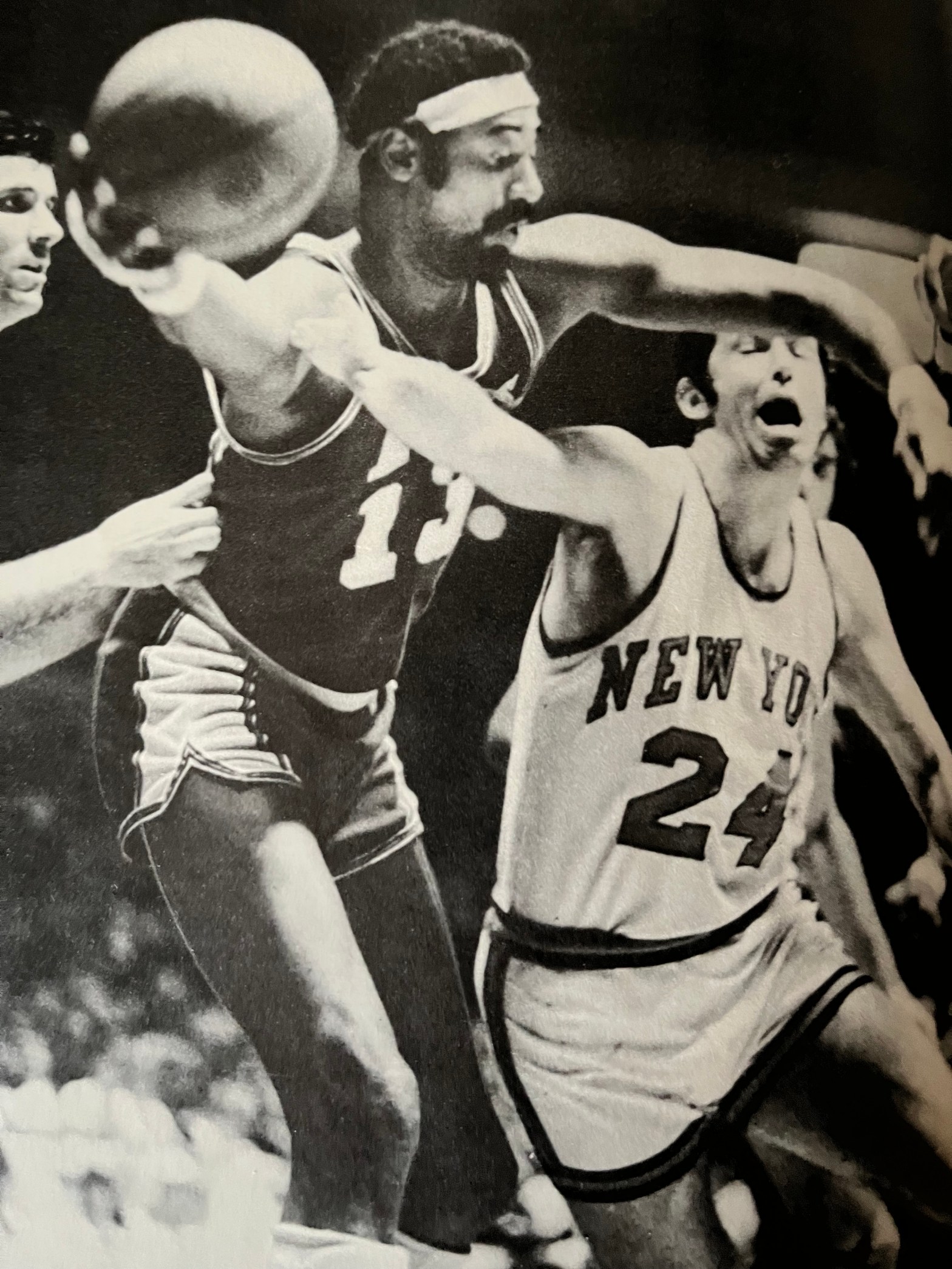
He leaped upward as he had done thousands of times before, his huge arm outstretched above him, his 7-foot-1 frame extended to its limit, his bearded face contorted in a determined scowl. The scene was Madison Square Garden in New York, before 19,500 fans at the fourth game of the playoff series for the [1972] championship of the National Basketball Association.
But it could have been any one of the schoolyards or gyms or arenas where Wilt Chamberlain has practiced his competitive art for most of his life. At 35, Chamberlain could no longer soar as high off the ground as he once did, and perhaps age, injuries, and his life of luxury had slowed his reflexes by a split second. But the essential situation had not changed. A rival was driving toward the basket, daring to challenge the big man in the area he was pledged to protect. It was the kind of naked, isolated moment that shelves reputations, million-dollar contracts, and even a team’s goals into the background and demands a purely individual assertion of strength and will—the moment that makes basketball just a little more than a game.
Straining mightily, Chamberlain responded to the challenge. His big hand met the ball with a satisfying, almost sensual slap, sending it bounding harmlessly away from the hoop. For the first 11 minutes of that important game, Wilt had appeared gripped by one of the lethargic, tentative moods that had subdued him in all too many big games over the years. Now he was suddenly aroused, defiant, ready to dominate. But the moment flashed by all too briefly, and it ended in pain. Thrown off balance by the force of his effort, Wilt descended onto the back of teammate Happy Hairston and then crashed to the floor on his back. As his head hit the wood, the thought crossed his mind: “After a fall like this, I’m probably hurt.” Then the exhilaration of the play dissolved into a bitter premonition. Chamberlain and the rest of the Los Angeles Lakers were on the verge of the championship that had eluded them in countless bizarre ways through the years; it was difficult to believe that they could be denied—by anything short of an unthinkable crippling injury. “Oh, no, man,” Wilt later recalled saying to himself. “This just can’t be happening to me again.”
The incident marked the beginning of a 48-hour ordeal for Wilton Norman Chamberlain. Even his considerable number of enemies and detractors could scarcely have contrived so devilish a test of the big man’s often-maligned courage and character under pressure. As Wilt arose from the Garden floor, the Lakers were leading the New York Knicks in the playoff series, two games to one. They were also trailing by one point near the end of the first period of the hotly contested fourth game. By all logic, they figured to beat the smaller Knicks, who had won 21 fewer games than Los Angeles during the 82-game regular season. But logic had failed both Chamberlain and the Lakers on similar occasions in the past; shaking his head as if to shake off the pain, Wilt couldn’t quite rid his mind of the fearful suspicion that sometimes approached— the feeling that the fates were closing in on him once again.
****
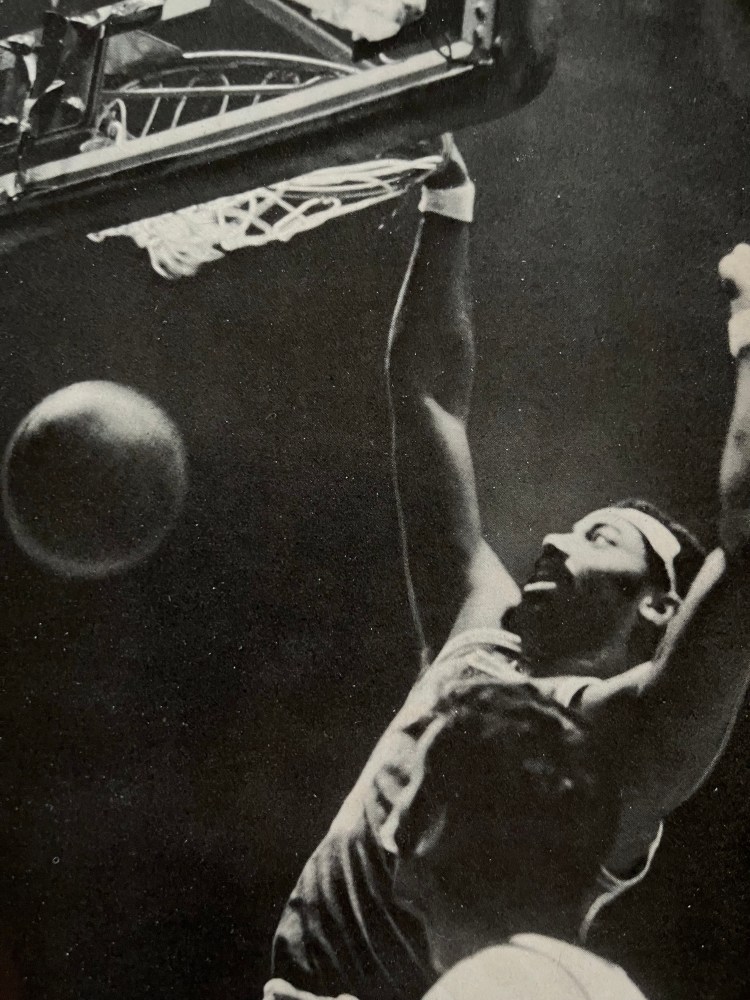
Throughout his record-breaking career in organized basketball, Chamberlain has been a towering stranger in an alien world, a victim of what he once termed “the Goliath complex.” Because his size and talents are so visible, he feels, people have always expected too much of him. “They see me score 75 points in a game,” he says, “and instead of saying, ‘Great game,’ they wonder why I don’t get 75 every night. They see me score a few inches away from the basket, and instead of appreciating the moves it took to work my way in that close, they say that the game is easy for me. Well, it’s not easy. But some people will never understand that.”
Wilt has a point when he laments, “Nobody roots for Goliath.” Many spectators find special delight in watching smaller men conquer an awesome giant; it makes good theater—even if it is hard on the villain. So when the Boston Celtics, the greatest pro team ever assembled, scored their annual playoff victories in the 1960s over Chamberlain and his old team, the Philadelphia 76ers, few fans acknowledged that the better team had won. In the public mind, it boiled down to a triumph of crafty, 6-foot-9 Bill Russell over his hulking rival. And as Chamberlain knew all too well, it was a script that the public loved.
If the villain’s role was unfairly thrust upon him, however. Wilt has sometimes seemed perversely determined to embellish it. He has skipped practices, feuded with coaches, and alienated teammates, contributing significantly to his own unpopular image. Few superstars in any sport ever get traded until their abilities have begun to decline; at the height of his career as the most dominant player in pro basketball, Wilt was traded twice, in return for players who barely belonged on the same court with him. And as he battled through the 1972 playoffs, he was reminded constantly that in a dozen years as the greatest scorer and rebounder in the history of the sport, he had managed to play on only one championship team. That was the most galling criticism of all: Being stereotyped as a villain was annoying; but it cut much deeper to be called a loser.
The losing image had not only lingered, but grown with the years. Unjustly maligned for losing to the Celtics in the early years, Chamberlain lost to them again with the Lakers in 1969, when Los Angeles was heavily favored. And as the final game of that series ended, Wilt was sitting ignominiously on the bench nursing a minor injury. Actually, he had asked to go back into the game and been refused by his coach, but the fans saw and remembered only the tableau of the giant star on the sidelines at the season’s climatic moment. Wilt was derided as a quitter, and Bill Russell himself commented, “With the championship at stake, one of our guys would have to break his back before he take himself out of the game.”
The following season was equally perplexing. After only nine games, Wilt ripped apart the tendons in his knee, necessitating surgery and supposedly finishing him for the year. But with a determination and courage that silenced even his detractors, he worked himself back into shape in time for the playoffs, then led the Lakers into the final round against the Knicks. When Willis Reed, the New York center, was severely injured early in the fifth game, it appeared that Wilt’s perseverance would be rewarded with the championship. But in still another shocking turnabout, Wilt inexplicably failed to take advantage of the smaller men who tried to substitute for Reed. The Lakers let the fifth game slip away. They won the sixth, but in the final encounter, the crippled Reed limped back into action, unable to jump or run but intent on somehow inspiring his teammates and psyching the Lakers. His appearance worked wonders. Chamberlain played as if mesmerized as the Knicks pulled away to an easy victory.
Those twin failures seemed to establish Wilt beyond doubt as basketball’s towering symbol of futility, a perennial foil for the Russells and Reeds, the heroes who possessed a certain quality— a sense of drama, a courage under pressure, perhaps even a bit of luck—that poor, talented Wilt apparently lacked. A few loyal friends and admirers excused his performances on the grounds of his physical ailments and pointed out, with justification, that the rest of the Lakers had done their share to bring about the defeats. But other observers who had sympathized with the younger Wilt found the older version unpalatable, and his critics turned on him more vociferously than ever. They claimed that his competitive instinct, which had never been described as fiery, had mellowed with age. For evidence, they offered a strange speech that the big man had delivered in the midst of the heated 1970 playoff against the Knicks, during which he speculated, “We Americans place too much emphasis on winning.”
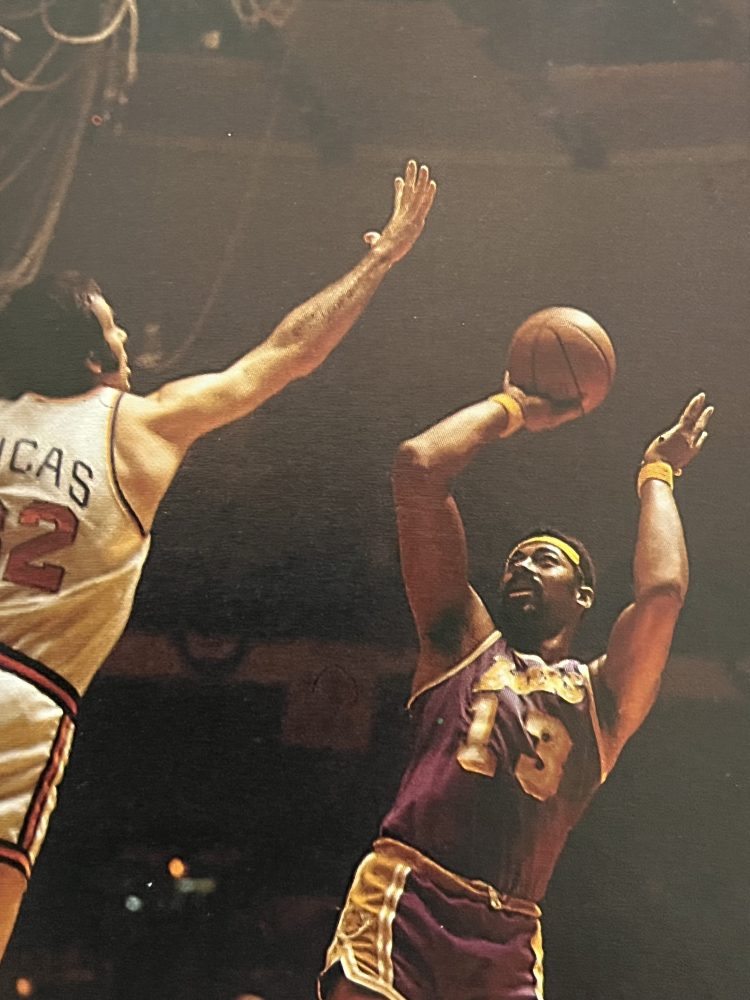
In the context of professional sports, that little meditation was nothing short of sacrilege. To working people who pay high taxes prices to watch men play games, it was outrageous that an athlete who was paid $250,000 a year to play those games could act less than totally consumed with the desire to win. Americans might expect statesman or philosophers to place victory and defeat in perspective, but their sporting heroes were supposed to mutter things like: “Winning isn’t everything. It’s the only thing.” When Chamberlain violated that code, his remark was taken as an admission of guilt—a simple answer to the riddle of why this particular Goliath seldom won the major battles.
But the answer wasn’t that simple. The controversial speech wasn’t really a plea of guilty; it was one of self-defense. That became clearer during this year’s playoffs, when a group of reporters approached Chamberlain about a stirring Laker victory. He bristled when asked if he felt, at that point, that the Lakers were the best team. “You guys will make us the best or the worst,” he snapped. “You place all the emphasis on winning. Our records and our achievements will all be forgotten if we don’t win it all. You make it that way.”
Wilt wasn’t minimizing the importance of a championship; indeed, he could scarcely hide his hunger for the title. But in echoing his earlier speech, he was pleading once more for a shift in emphasis—a recognition that even without winning, he had accomplished more than almost anyone who ever played basketball. It was an honest enough expression of his emotions and effort to communicate, to be understood. But like so many similar efforts throughout his troubled career, it fell short of its goal. And instead of providing a simple answer, it only deepened the mystery surrounding the enigmatic star.
The fact is that, for all the style and bravado he tries to project, Chamberlain is a shy and lonely man. He is cautious in choosing his friends, uncomfortable and suspicious with outsiders. In small talk with familiar faces on the basketball scene, he can be relaxed and entertaining. But when he dares to express more personal, sensitive feelings, he grows unsure and hesitant. Too often his attempts at honesty and candor are interpreted as arrogance or churlishness; his self-analyses are ridiculed as empty rationalizations. And having been burned too many times, he acts wary and threatened, hiding his scars under a veneer of toughness and independence—a veneer that only compounds his difficulties by creating the impression he doesn’t give a damn.
Beneath the surface, however, the scars are real. The “Goliath complex” goes much deeper than the theatrics of basketball. Growing up Black and a foot taller than everyone else in the streets of Philadelphia, Wilt knew the humiliation of being laughed at as a freak or goon. Ordinarily, time and maturity might have helped him to overcome such slights, but ironically, Wilt’s athletic ability denied him the luxury of time. As a high school prodigy besieged by recruiters from some 200 colleges, he found himself a superstar before he ever had a chance to find himself as a person.
Rushing headlong into the national spotlight, pursued from all sides by men who saw profit in his talent, the young star tried to comprehend his complex surroundings in simple, childlike terms. “I used to think of myself as climbing a high wall,” he once said in an introspective moment. “Some people were helping me up, but a lot of others were trying to pull me back down.”
Chamberlain played college ball for three years at Kansas, growing more convinced with every game that most of the world was lined up on the wrong side of his imaginary wall. Off the court, he was questioned repeatedly about how much money the university was paying him under the table; fans and writers were far more interested in his alleged “salary” than they were in his troubled personality. On the court, he was jostled and mauled by defensive players who were assigned to stop him at all costs. In a hint of things to come, he was roundly criticized for twice failing to lead Kansas to a championship. Disillusioned, he left school to join the Harlem Globetrotters.
A year later, accompanied by a vast publicity buildup, Chamberlain joined the Philadelphia Warriors of the NBA. It soon became apparent that his gifts surpassed those of anyone who had ever joined the league. Averaging 37 points a game, he was named Rookie of the Year and generated tremendous excitement in every city he visited. “He’s made the whole country conscious of the NBA,” said the Celtics’ Russell. “He’s made it a big league.” If others were fully conscious of Chamberlain’s identity, the star himself was still confused.
Desperately seeking approval, Chamberlain altered his style several times through the years. When he broke a lot of scoring records and was accused of being selfish, he decided to prove his selflessness with a vengeance—and became the only center who ever led the league in assists. Faulted for careless play on defense, he developed himself into a fearsome shot-blocker. In fact, he mastered every aspect of the game but one: He remains a poor foul shooter.
The adjustments were never quite enough, however, to satisfy some people, and they left the big man with a residue of bitterness and frustration. When the matchup against Jerry Lucas in last spring’s playoff finals demanded yet another drastic shift in emphasis from defense to offense, Chamberlain complied—but not without frequent expressions of annoyance. “I don’t know of any athlete who’s ever been asked to change so often,” he said. “It’s not impossible, but it is tough on me, and I wish people would realize it.”
Off the court, Wilt has broadened himself in many ways, as if determined to put to rest the hated insinuation that he is simply a freakishly gifted physical specimen. He reads extensively and speaks five languages; he insists on playing a personal role in his various financial dealings. In recent years, he has also become involved in politics, risking the censure of many Blacks by speaking out for Richard Nixon.
Above all, Chamberlain has sought to overcome the various travails of his existence by submerging himself in a luxurious, voluptuous lifestyle that assures his place on any all-time, all-pro team of hedonists. And while he has long shown his affinity for flashy cars, fine women, and elegant living, it was only in 1968—when he was traded from Philadelphia to Los Angeles—that Wilt was able to stretch out in a land that has room for his body and his dreams. The California culture, with its emphasis on style over substance and pleasure over almost everything, provided an atmosphere in which Chamberlain could truly breathe. Arriving at the age of 31 in the land of stars, Wilt was finally able to carve out an environment all his own—one that culminated in his $1.5 million dream house on a hilltop above Bel Air.
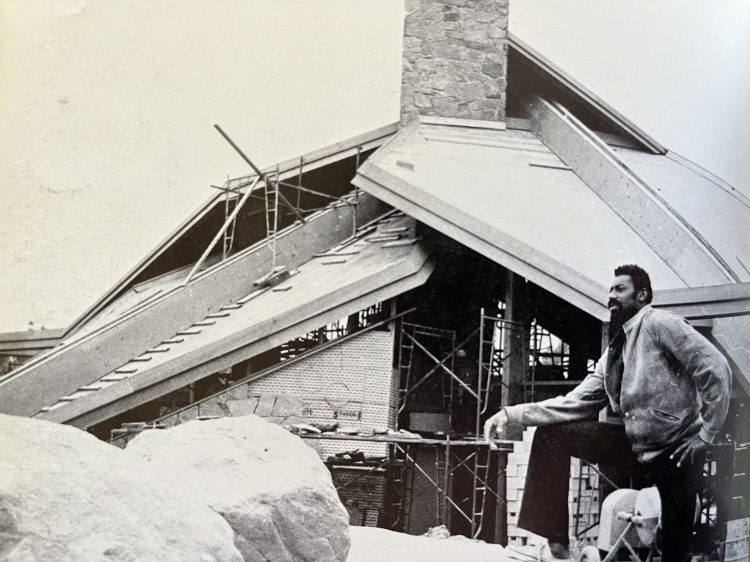
The house, rising in triangular splendor from a $135,000 lot that was once the site of a World War II anti-aircraft encampment, took three years to build. Wilt not only specified the gigantic dimensions, from the 45-foot living-room ceiling to the 72-square-foot bed in his own room; he also handpicked the Brazilian rosewood paneling, the custom-made furniture, the huge collection of art.
From his own bed, Wilt can control almost everything in his private world, pushing buttons to open and close various gates and curtains, to fill his huge sunken marble bathtub, or to dazzle his guest of the moment by sliding back the ceiling and revealing a great triangular slab of sky. Staring down from his patio at the view across Stone Canyon and the Pacific, he fairly glows with pride. Here there is no intrusive hint that life has been anything less than glorious for Wilt Chamberlain.
****
Considering his environment, his fortune and the wisdom—or at least the equanimity—he had acquired through his 13 seasons, Wilt would undoubtedly have survived another disappointment in the 1972 playoffs. If the fall he took in that fourth game against the Knicks had sidelined or hampered him enough to let the title slip away, the criticism would have been brutal for a while, but life would have gone on up on his hilltop. Was the importance to him of this particular championship being exaggerated by the press and the fans?
“I have become sort of calloused over the years,” he said. “When your whole life is basketball and you can’t seem to win the big ones, it takes a lot out of you emotionally. And yet, when I think about the season, I feel I want this title even more than the first one I won.”
Throughout the last season, the Lakers had all done their jobs better than any team in NBA history—largely through the efforts of the Coach of the Year, Bill Sharman. Taking over a team that was scarcely expected to contend for the title, Sharman had driven the Lakers into super physical condition and then built them into a fast-breaking club that could run its opponents off any court. To get results, Sharman talked so constantly that he ended the season rasping at his players threw a bullhorn because of severe laryngitis.
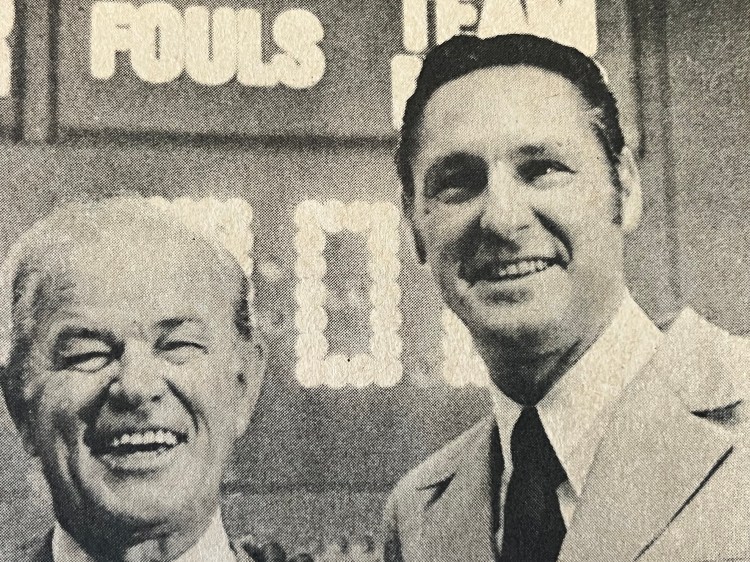
But the results spoke eloquently for him: The Lakers put together their incredible 33-game winning streak—the previous record had been only 20—and shattered another record by winning 69 games during the regular season. Jerry West, Gail Goodrich, and Jim McMillian enjoyed great offensive seasons under Sharman’s system, and Chamberlain did exactly what his coach asked, concentrating on rebounding and defense and triggering the fastbreak with this passes. Even more significantly, the big man who had cost more than one earlier coach his job responded enthusiastically to Sharman: Wilt set a personal record by attending every single practice session of the year.
Despite their regular-season records, the Lakers faced a formidable task in the playoffs. Their first opponents, the Chicago Bulls, were decimated by injuries, but beyond them loomed Kareem Abdul-Jabbar and the defending-champion Milwaukee Bucks. And then the winner of the Bucks-Lakers series would have to maintain the physical and emotional strength to get past the survivor of the supposedly weaker Eastern playoffs. The real danger, however, lurked less in the opponents than in the Lakers themselves. In 11 previous years in Los Angeles, they had reached the final round seven times, only to be heartbreakingly defeated.
But these playoffs offered a new script, promising a welcome new ending for the Lakers. West, at 33, remained one of the most popular men who ever played the game. Patient and gracious even when pressed to explain his many near-misses or the perplexing shooting slump that afflicted him during these playoffs, West had almost everyone in basketball hoping that he would win at least one title before the seasons ran out on him. As Chamberlain said, “If there’s any justice in these things, it’s owed to Jerry.”
For Wilt, 35, the playoffs offered another kind of poetic justice; at last, the feared unpopular Goliath figure was playing for the other side. Abdul-Jabbar was taller, quicker, and much younger than Chamberlain, and he had fashioned a villainous reputation that was every bit as convincing as Wilt’s had once been. While Chamberlain preached and practiced the tried-and-true values of Americanism, capitalism, and materialism, Kareem alienated many Middle American fans with his Islamic faith, militant attitude, and haughty manner.
As a hardened veteran and comfortable millionaire, Wilt was less concerned about the fans’ sentiments than he might have been a decade earlier, but he admitted that his new role had an effect on him. “I’m delighted to be looked at in a favorable way,” he said. “A lot of people seem to be changing their minds about me, and I think it goes a little deeper than just rooting. I’m very grateful.”
Hustling at a pace he had seldom equaled during his younger days, Chamberlain kept constant pressure on Abdul-Jabbar. He didn’t “stop” the bigger man, any more than any defender had ever stopped Wilt during his prime. But he did keep Kareem harassed and off-balance, forcing him to struggle for every basket and every rebound—and that was all the Lakers needed.
There were four one-sided games in the series; each team won two. But the second and third games were frantic and wildly unpredictable—the kind that had to be decided in the final seconds, the kind that the Lakers had so often contrived to lose. They won them both, and the way in which they won seemed to signify this was, at last, the Lakers’ year.
The second game was one of the most beautifully played, exciting, and bizarre in NBA history. The Lakers, who had managed a feeble 73 points while losing the series opener, shot brilliantly, but Abdul-Jabbar’s 40 points kept the Bucks in competition. With seconds left, Los Angeles led by a point. West, bringing the ball upcourt, was met by Kareem, showing his fantastic agility for a big man by rushing out to disrupt the Laker offense. As a horrified crowd in the Inglewood Forum gasped, it happened: West, the man who wanted the title so badly, the one the loyal fans called “Mr. Clutch,” lost the ball. As it bounced toward the sidelines, Jerry could have watched another season eluding his grasp. “I might have, if there had been time,” he said later. “But it happened so fast, I didn’t think at all.”
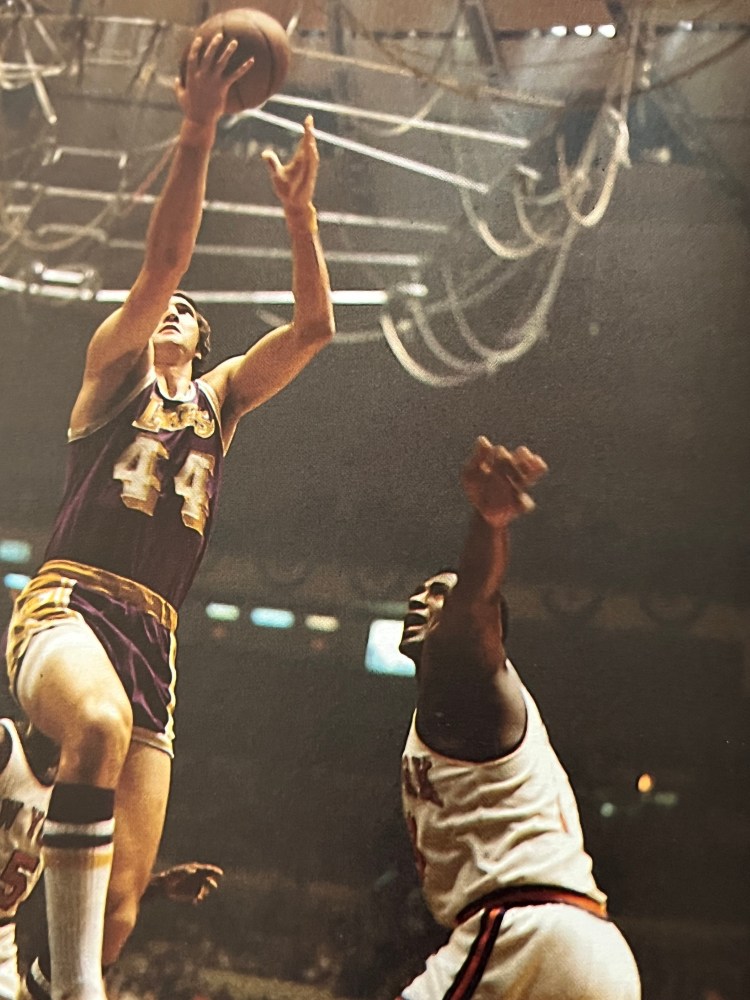
Then West got an undreamed-of break. Official Manny Sokol, watching the play, got in the way. The ball hit him in the stomach and stayed in play. Given that otherworldly reprieve, West grabbed the ball and fired a pass to Hairston, who scored to wrap up the game.
In the very next game, the Lakers led by a single point in the closing seconds; then the Bucks fouled Chamberlain. The likely scenario was familiar. Wilt was not only the worst of all foul shooters, but his average always dipped even lower under our playoff stress. If he missed the free throws, the Bucks could rush downcourt and score, and Wilt would be credited with blowing another big one. The Milwaukee crowd did its part, booing wildly as Chamberlain eyed the basket, his head cocked to one side, his body arched slightly backward. He made two foul shots to clinch the game.
Only the Knicks remained in the Lakers’ path: The patched-up, reconstructed Knicks, with only the seventh-best record in the NBA, a mere shadow of the team that had whipped the Lakers two years earlier. The Los Angeles players were understandably confident. “To be honest about it,” one player confided, “we figure that the Knicks might win one game if their outside shooters get hot. But there’s no way they should win the series.”
Then that one game happened. Passing and shooting with uncanny accuracy, the Knicks put on an almost perfect demonstration of basketball to win the opening game at the Forum. Many of the fans who began filing out midway through the second half were muttering in disgust about their own club. Chamberlain appeared rooted to the floor beneath the basket as New York center, Jerry Lucas, the 6-foot-8 replacement for Wilt’s former nemesis, the ailing Willis Reed, scored freely from outside.
Before the second game, Coach Sharman was going over the plays he had diagrammed on a green blackboard. He placed special emphasis on No. 5. The sketch depicted Chamberlain on offense, driving toward the basket against the smaller Lucas. Under it, Sharman had scrawled, “Don’t cut through. WILT ONE-ON-ONE LUCAS.” That was the key to the Laker strategy. After a season of emphasizing rebounding and defense, Chamberlain had to reach back in time and become an offensive star again. Only by driving to the hoop could he exploit Lucas’ stature, disrupt Lucas’ concentration on offense, and perhaps even get him into foul trouble.
With Chamberlain wheeling and dealing in the low post and scoring with the dunks and backward “finger rolls” into the hoop, West’s continued slump barely mattered. The Knicks had two defensive weaknesses—Lucas’ lack of height and Earl Monroe’s inconsistency. While Wilt exploited the first, little Gail Goodrich consistently drove around Monroe to score. It was cold, logical, blackboard-diagram basketball, and particularly when hustling Knick forward Dave DeBusschere was slowed by an injury, it seemed to make the Laker championship inevitable.
Yet Chamberlain expressed little satisfaction about it. He was strangely sullen and quiet after the second game at the Forum, only slightly more outgoing after the third in New York. (Partly out of resentment toward some Los Angeles writers, he generally seemed more relaxed and garrulous around New Yorkers.) “I’m tired,” he said. “It’s been a long, long road. When it’s finally over, I’m going so far away, you’ll need a boat to find me.”
“We’re not exactly tearing the dressing room down yet,” added West. “After all, we’ve been this close before.” Then his caution was justified all too graphically when Wilt crashed to the Garden floor.
****
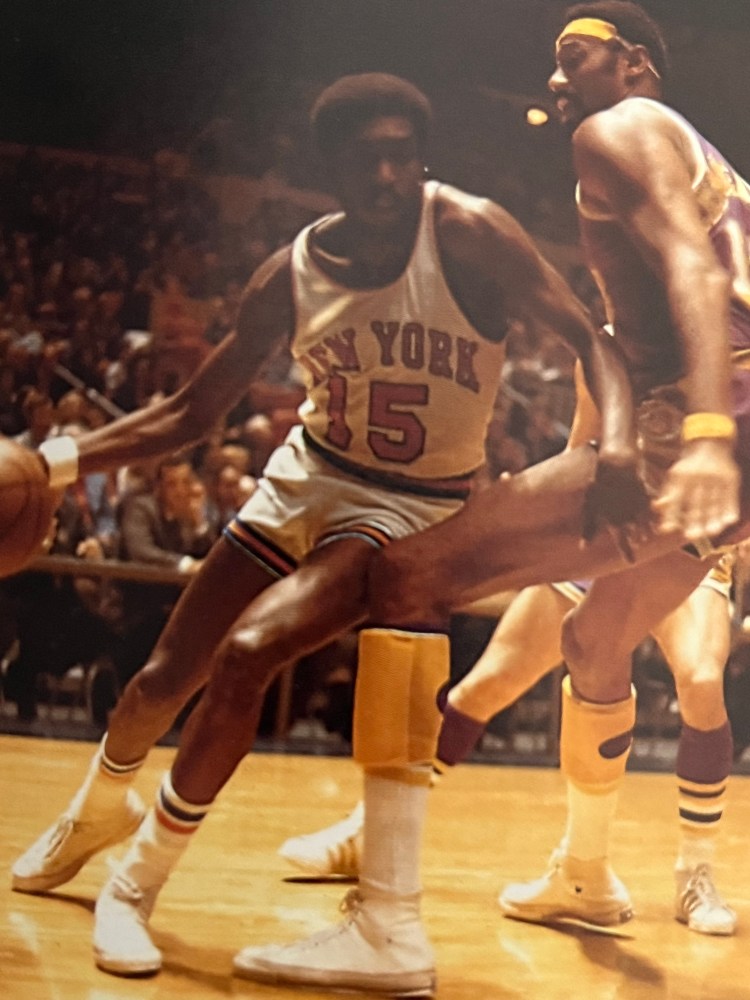
Wilt’s initial fears dissolved as the pain in the back of his head faded, but he still appeared reluctant or unable to reassert his offensive dominance. The game stayed even all the way, until West scored with 13 seconds left to give the Lakers a two-point lead. Then Wilt’s recurring playoff nightmare came alive once more. DeBusschere threw up a final shot and missed, and the ball caromed safely down into Chamberlain’s hands. But somehow, he let it slide through his grip; the brilliant Walt Frazier grabbed it and tapped it in to send the game into overtime.
The pain and frustration in Chamberlain’s scowling face was visible even in the distant rows of the Garden as he walked to the bench. He had already been called for five personal fouls, and through his own miscue, he now faced five more minutes of play in imminent danger of fouling out for the first time in his career—and all but ruining the Lakers’ chances. To make matters worse, West was still having trouble with this shooting.
In the team huddle, Sharman didn’t seem to give those problems a thought. “Let’s go to Jerry,” he rasped. “Get him the ball.”
“Jerry could have been 0-for-20,” said Jim McMillian, “and we’d still go to him. And because we all kept our confidence in him, we all kept our self-confidence.” The mood was infectious. Wilt shoved his foul situation from his mind and blocked several shots. West and McMillian sparked a quick rally. The Lakers won by five.
Afterwards, Chamberlain joked about both his fall and the rebound that had almost cost him the game. Doing a rough imitation of [boxer] Sonny Liston, he said, “I felt like staying down for a count of nine. But I might have been like Sonny and forgot to get up at all.” Wilt smiled. “It’s very nice for a change to have some terrible things happen in a game—and still win.”
But Chamberlain’s trials were far from over. Although his head had not been injured, he had used his right arm to break the fall—and overnight the wrist swelled up alarmingly. Playing hearts on the plane back to Los Angeles the next day, Wilt found that it hurt just to deal the cards; when he debarked, he left for the hospital with team physician Robert Kerlan. Hours later, the report was out, Wilt had a “severely sprained” wrist—and he was a “very, very doubtful” participant in the next day’s fifth game and any games to follow.
Returning to his home to treat the injury in the giant whirlpool adjacent to one of his swimming pools, the big man remained in remarkably good spirits. “The way it feels right now,” he said, “I’ll probably have to let Leroy Ellis take over for me.”
That evening, he entertained Frank Blauschild and Jim Wergeles, two friends who worked in the Knick front office. He was lying in the whirlpool when they arrived but got up quickly to show his guests around the house. “It still bothers me too much,” he said as he poured them huge tumblers of Canadian and Scotch. “I don’t expect to play.”
“Bull,” said Blauschild. “I’ve been watching you pour. You’ll play.”
Chamberlain slept only three hours that night. He spent the rest of the time alternately applying ice and the whirlpool to the wrist. When he arrived at the Forum for the game, he was injected with Celestone, an anti-inflammatory agent. Then Dr. Kerlan fashioned a splint for him, surrounded by the padded prop that football linemen use.
If anything, the injury seemed to drive him to do more than ever to the poor Knicks. He ranged far from the basket to block shots, took full control of the backboards, and scored over Lucas for a series of smashing stuff shots. At no point did he suffer any of the lapses in concentration or periods of exhaustion that had marked his playoff career. In short, he was everything that people have always said he should be on a basketball court—a towering presence who made the Lakers’ long-awaited championship victory look easy.
After the triumph, Wilt was philosophical. “I’ve made a lot of friends over the years,” he said, “in Philadelphia, in New York, out here in California. When people write or say things about me that aren’t fair or true, I think about those friends. I don’t hear the stuff that’s said behind my back, but they do. Right now, I can’t think of anything greater about winning than the knowledge that all those people who’ve believed in me can walk in peace—like I do.”
The interviews went on, and the champagne just kept flowing. Finally, the spacious room emptied out and only West and Chamberlain remained. “A whole season of working for this,” said Wilt, “and now the game’s been over for an hour and everybody’s gone. Well, I can dig it. It belongs just to us now.”
For a moment, the two stars met in the center of the room and embraced happily. Then they were headed for the door, toward the autographed seekers and friends and the summer they had awaited for so long. “You know, Jerry,” said Wilt Chamberlain, “you stick around with me, and we may make a hell of a basketball team.”

